
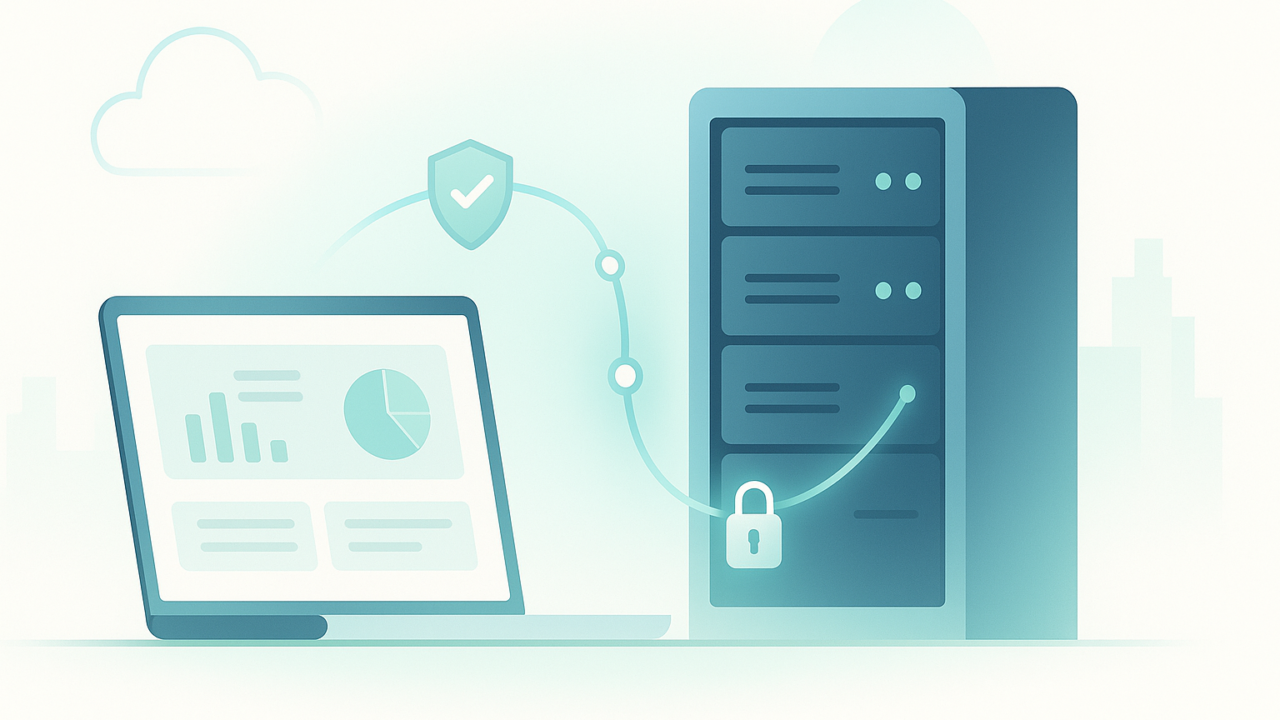
Why local-first now
For product teams operating under auditors, VPNs, and latency budgets, the path from feature to value increasingly runs through local-first deployment. When the application executes where the data already lives, round-trip risk shrinks, performance becomes predictably boring, and infosec stops being an obstacle course of exceptions. This isn’t a nostalgia tour for on-prem; it’s a recognition that regulated workflows don’t forgive flaky links or third-party churn. As software engineer and leadership coach Denis Ermakov puts it, “We’ve adopted a ‘local-first’ approach, which has proven highly beneficial in providing a seamless experience.” Local-first doesn’t preclude cloud; it simply restores optionality—let the network be an optimization, not a dependency. For product managers, that translates to cleaner SLOs (interaction latency, offline tolerance) and fewer moving parts to explain at change boards.
Value over velocity
Most organizations still count output better than outcomes. The fix isn’t more tickets; it’s a shorter path to reality. Teams that instrument by default, observe real user sessions early, and budget time for ride-alongs discover that the biggest wins are often in the “in-between”: navigation freezes, blocking modals, retries that look like success in logs. Ermakov’s framing is a useful north star: “Code is just a set of words we use to describe business needs… all code is simply the result of communication.” Treating code as communication pushes product and engineering toward the same questions: which flows gate revenue or compliance, where does latency hurt decisions, which dependencies expand your blast radius? When you optimize those answers, “velocity” starts to mean value delivered per unit time, not burndown theatrics.
Scaling without ceremony
Big companies don’t fail for lack of frameworks; they fail the math of communication. Links between people grow as n(n–1)/2, so control-heavy hierarchies often throttle discovery just when you need it most. The scalable move is to engineer information flow: clear interfaces between teams, objective-driven swarming, telemetry that makes truth obvious, and governance that invites security and operations early instead of late. Ermakov’s summary is plain: “Making this mindset shift—from managing individuals to managing processes—is, in my experience, the biggest challenge in scaling Agile methodologies.” Leaders who remove conversational friction, sell trade-offs cleanly, and extend trust find they need less micromanagement and get fewer “heroic” saves—because the system stops requiring heroics in the first place.
What to do this quarter
If you build or buy enterprise software, bias toward less and closer. Offer a local-first (or customer-cloud) option that passes infosec without bespoke waivers. Set SLOs in user terms—time to interactive, interaction latency, offline behavior—and wire dashboards so PM, Design, and Eng see the same numbers. Cap bundle sizes before you cap story points; retire long-tail dependencies that can’t meet your audit cadence. And schedule reality checks as a ritual: ride-alongs with operators, heatmaps and traces in joint reviews, and post-release “go-and-see” sessions. As Ermakov reminds teams, “For me, the core principle Scrum taught is to focus on the single most important task at hand and to continuously reflect on how to improve my work and the team’s performance.” Paired with a local-first baseline, that discipline turns code into product—and product into progress.