
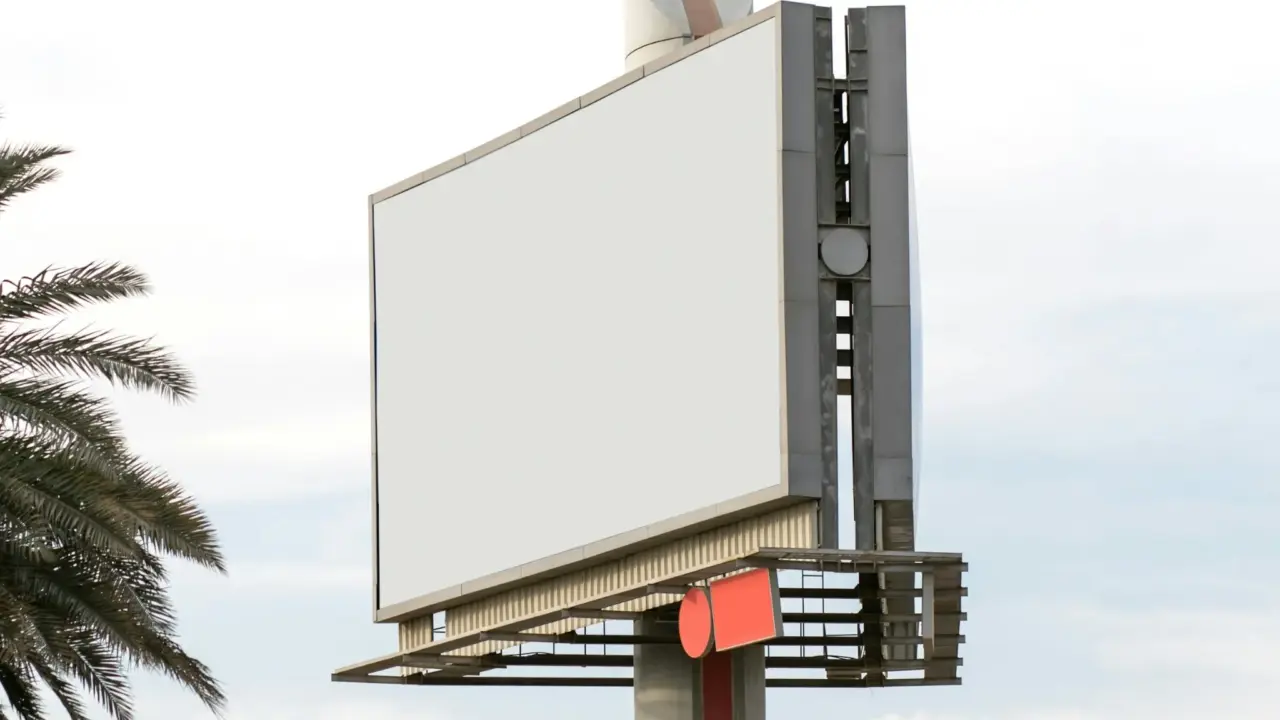
Weather has always been the main challenge for outdoor advertising. Rain, wind, humidity, sunlight, and temperature changes all put stress on the billboards you see along highways and city streets.
Still, billboards keep working reliably, even after years of harsh weather. This durability comes from a mix of strong engineering, advanced materials, waterproof electronics, and smart digital systems that have turned billboards into high-tech advertising platforms.
Billboards survive tough weather thanks to a mix of civil engineering and modern technology. Older billboards are built to handle strong winds and rain, while newer digital billboards use sealed electronics, weatherproof screens, and remote monitoring so operators can keep them running smoothly.
Engineering Structures That Survive Wind and Rain
The first challenge for any billboard is structural stability. A billboard behaves much like a giant sail: when strong winds hit the large surface area of the advertisement panel, enormous pressure can be exerted on the support structure.
According to research published by the Federal Highway Administration (FHWA), billboard structures must be designed to withstand significant wind loads because large outdoor signs present considerable surface area to wind forces and must be engineered to prevent structural failure.
Engineers solve this problem with smart design. Most billboard frames use strong steel trusses and deep concrete foundations. These foundations keep the billboard firmly in place and help spread out the force from the wind.
Engineers also carefully plan which way billboards face. They study local wind and terrain to make sure the structure can handle even the worst storms or hurricanes. In many places, billboards must meet building codes for wind speeds over 100 miles per hour.
The American Society of Civil Engineers explains that outdoor structures exposed to environmental forces must follow strict design standards because wind loads are one of the most critical considerations in the design of large sign structures.
As a result, modern billboard frameworks often resemble the same type of engineered systems used in bridges and towers, incorporating structural redundancy and fatigue-resistant materials that allow them to endure years of environmental stress.
Weatherproof Materials That Resist Rain and Corrosion
Rain is another big challenge. If billboards are not protected, constant moisture can cause metal parts to rust and printed materials to wear out.
Outdoor billboards typically use galvanized steel or aluminum alloys for their frames. Galvanization involves coating steel with a protective layer of zinc, which prevents rust formation when the metal is exposed to moisture.
According to Galvanizers Association, galvanizing protects steel structures because the zinc coating forms a barrier that prevents corrosive substances from reaching the underlying steel.
This protective coating helps outdoor billboards last much longer. In many places, galvanized steel can last for decades, even with regular rain and humidity.
For the advertising surface itself, printed billboard graphics are produced using vinyl materials designed to resist water damage and ultraviolet radiation. Vinyl is widely used in outdoor advertising because it is both flexible and waterproof.
Thanks to these coatings, billboard graphics stay clear and bright, even after months of rain and sun.
Drainage Systems and Surface Design
Drainage is another important part of billboard design that people often forget. Rainwater can’t be allowed to collect on the billboard, since standing water adds weight and can cause rust.
To prevent this, billboard panels are designed with subtle angles and drainage pathways that allow water to run off quickly. Even the mounting systems used to hold vinyl advertisements include small gaps that allow moisture to escape rather than becoming trapped behind the display surface.
Engineers also incorporate weather-resistant sealants around joints and fasteners to prevent water infiltration into structural components.
These details may seem minor, but they are critical for long-term reliability. Without proper drainage and sealing, water could slowly weaken the structure over time.
The Rise of Digital Billboards
Over the past two decades, billboard technology has undergone a dramatic transformation with the introduction of digital displays. Instead of printed advertisements that must be replaced manually, digital billboards use large LED screens capable of displaying multiple ads that change throughout the day.
Digital billboards bring a new challenge: keeping their sensitive electronics safe from the weather.
According to Alibaba, digital billboards rely on weatherproof enclosures that protect internal electronic components from rain, dust, and temperature changes. These enclosures are sealed to meet industrial protection standards that ensure reliable operation in outdoor environments.
Most modern digital billboards use IP-rated enclosures, which indicate how well the equipment is protected against environmental elements. These enclosures prevent water intrusion even during heavy rain.
The LED panels themselves are designed for outdoor use and contain thousands of tiny light-emitting diodes sealed within waterproof modules. If one module fails, it can often be replaced individually without dismantling the entire display.
Temperature Control and Smart Cooling
Rain isn’t the only thing billboards have to deal with. Electronic displays also get hot, and too much heat can harm the circuits inside.
To solve this, digital billboards use advanced cooling systems. These systems control the temperature with vents, heat sinks, and sometimes fans or other cooling devices.
Research from the Institute of Electrical and Electronics Engineers (IEEE ) explains that LED display systems require thermal management because heat dissipation is essential to maintain LED efficiency and prolong device lifespan.
Outdoor LED panels therefore incorporate aluminum heat-dissipation structures that allow heat to spread across the display surface and dissipate safely into the surrounding air.
In cold places, heating systems are sometimes added to stop condensation or ice from forming inside the billboard’s electronics.
Smart Monitoring and Remote Maintenance
Turning billboards into digital platforms has made remote monitoring possible. Today, many billboards are connected online so operators can check how they’re working in real time.
Digital billboards have sensors that track things like temperature, power use, and system health. If something goes wrong, operators can figure out the problem from a distance before sending someone to fix it.
These remote management capabilities are part of a broader shift toward smart infrastructure. In many cities, digital billboards are integrated into connected networks that allow advertisers to update content instantly across hundreds of locations.
This technology has changed outdoor advertising in a big way. Instead of showing the same image for weeks, digital billboards can switch ads every few seconds and even change messages based on the time, weather, or local events.
Data-Driven Advertising
Another big change is the use of data analytics. Today’s advertising networks use traffic counts, mobile data, and location tracking to see how many people notice a billboard.
Some digital billboards can even change their ads on the fly. For example, they might show different ads when it’s raining compared to when it’s sunny.
Blueconic notes that digital out-of-home advertising is becoming increasingly data-driven, allowing advertisers to deliver dynamic content that responds to contextual conditions such as time, weather, and audience patterns.
Because of these features, billboards are no longer just static ads—they’re now interactive communication tools.
Sustainability and Energy Efficiency
As billboard technology evolves, sustainability has also become an important focus. Traditional billboard lighting systems consumed large amounts of electricity, but LED technology has significantly improved energy efficiency.
LED displays use less power than older lights, but they’re also brighter and easier to see.
Solar power systems are also being explored as a way to reduce the environmental footprint of billboard networks. In some installations, solar panels are integrated into billboard structures to provide supplementary energy for lighting or display systems.
Sustainability is especially important as cities try to use less energy but still keep their advertising systems running.
The Future of Billboard Technology
The next generation of billboard technology may integrate even more advanced systems, including artificial intelligence, augmented reality, and environmental sensors.
Some new billboards can already spot traffic patterns nearby and change ads to match. Others might let people interact with ads using their phones or other devices.
Better materials could make future billboards lighter and stronger, so they can handle even tougher weather.
At the same time, better display technology could make digital billboards use less energy and be better for the environment.
Advertising Structures Built to Endure
A billboard might look simple, but it’s actually the product of advanced engineering and technology. With wind-resistant designs, waterproof materials, sealed electronics, and smart monitoring, today’s billboards are made to last for years while sharing ads with the public.
Rain may fall relentlessly on these structures, but behind the scenes, decades of engineering research ensure they remain standing — and shining — above the roads where millions of people pass every day.
So, billboard technology isn’t just about advertising. It shows how engineering, materials science, and digital innovation can turn even everyday parts of our cities into tough, high-tech systems.