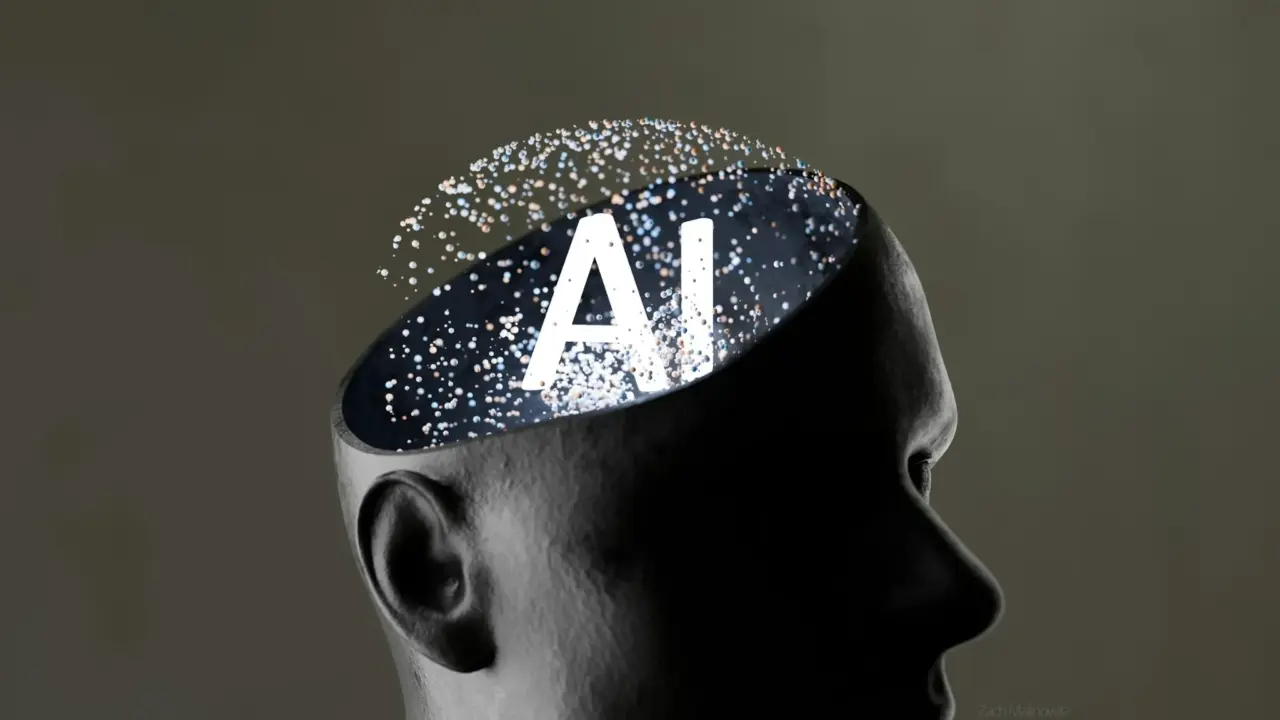

When people ask whether they can be smarter than technology, they usually are not asking about raw speed. They are asking whether they still matter when software can search faster, summarize faster, calculate faster, and sometimes outperform humans on specialized tests. The honest answer is yes — but only if “smarter” means more than producing quick answers.
If intelligence means recall, pattern matching, and first-draft generation at scale, then modern AI is already better than most humans in many narrow tasks.
But if intelligence means judgment, context, verification, and knowing when an answer should not be trusted, humans still have a strong edge.
The next few years will not be defined by humans trying to beat machines at machine strengths. They will be defined by whether people can stay thoughtful enough to use powerful systems without surrendering their own reasoning.
That distinction is becoming more important as AI gets cheaper and more capable.
Stanford’s AI Index 2025 says AI systems made major gains on difficult benchmarks in 2024, while the cost of inference for GPT-3.5-level performance dropped more than 280-fold between late 2022 and late 2024.
That means AI is not only improving; it is spreading. The real question is no longer whether the tools are impressive. It is whether people know how to work with them without becoming mentally passive.
AI is powerful, but its intelligence is uneven
One of the biggest mistakes people make is assuming that because AI is very strong in one area, it must be equally strong in nearby tasks. Research suggests otherwise.
In Navigating the Jagged Technological Frontier, researchers describe AI’s capability as a “jagged technological frontier.” That phrase matters because it captures something users feel in practice: AI can look brilliant one moment and unreliable the next.
In their study, AI improved consultant performance on many tasks, but not uniformly. Some assignments benefited a lot. Others revealed clear limitations. The lesson is simple: AI competence is real, but it is irregular. A person who assumes that fluency equals full understanding is exactly the kind of user most likely to be misled.
This is one way humans can still be smarter than technology: by understanding where the system’s strengths end. That kind of intelligence is not flashy. It is the ability to recognize when a polished answer hides weak reasoning, when a confident summary is too neat, or when a system is operating outside its strongest domain.
Machines are often better inside a defined frame. Humans are still better at asking whether the frame itself is wrong.
The human advantage is shifting toward judgment
That shift shows up clearly in research on human-AI teamwork.
In Toward a Science of Human–AI Teaming for Decision Making, the authors argue that AI is well suited for continuous scanning, prioritization, misinformation filtering, and early-warning projections. Humans, by contrast, bring broader contextual understanding, novelty detection, and judgment about what matters.
That is a useful way to think about the future. AI is becoming very good at processing within a system. Humans remain more valuable when they have to decide what the system is for, what tradeoffs are acceptable, and what should happen if the system is wrong.
NIST makes a similar point in its AI Risk Management Framework, which emphasizes that AI risk must be evaluated “based on context.” That is important because real intelligence is not only about getting an answer. It is about knowing what kind of answer is appropriate in a particular setting, what risk comes with error, and who bears the consequences.
Technology can optimize within rules. Humans still decide whether the rules make sense.
The bigger risk is overreliance, not machine superiority
If there is one reliable way humans become less smart around technology, it is by trusting it too much.
Research on automation bias has warned about this for years. Reviews indexed in PubMed and PubMed describe automation bias as the tendency to over-rely on decision-support systems, reducing vigilance in information seeking and evaluation. In other words, the danger is not only that the system makes mistakes. It is that people stop doing the checking that would catch them.
That issue is becoming more visible with generative AI.
Microsoft Research’s The Impact of Generative AI on Critical Thinking surveyed 319 knowledge workers across 936 real-world use cases and found a striking pattern: higher confidence in GenAI was associated with less critical thinking, while higher self-confidence in doing or evaluating the task was associated with more critical thinking.
The paper says generative AI shifts cognitive effort away from producing work directly and toward verification, integration, and “task stewardship.”
That is a huge clue. The human role is not disappearing. It is moving. But if people become too impressed by the output, they may underinvest in the very kind of thinking that keeps them useful.
So yes, you can still be smarter than technology — but only if you keep hold of judgment instead of outsourcing it.
Technology can make you better, but only if you stay active
The story is not purely defensive. AI can genuinely improve human performance when used well.
In the NBER paper A Field Experiment on Generative AI Reshaping Teamwork and Expertise, researchers found that AI could act as a “cybernetic teammate.”
Individuals working with AI produced solutions at a quality level comparable to two-person teams, and workers could use AI suggestions to bridge gaps in expertise that would previously have required more human collaboration.
That is powerful. It suggests AI can extend human capability, not just threaten it. But it also changes what being “smart” looks like. The smartest person in an AI-rich environment may not be the one who knows the most from memory.
It may be the one who knows how to frame the problem, ask for useful alternatives, verify what comes back, and recognize when the system is drifting.
That is why the best use of AI often looks less like asking for a final answer and more like asking for a first pass, a comparison, a list of blind spots, or a structured set of options. The human becomes less like a typist and more like an editor, reviewer, and decision-maker.
What being smarter than technology looks like in real life
In practice, staying smarter than technology means using it asymmetrically. Let the machine do what it does unusually well: scan large information spaces, summarize, compare patterns, generate drafts, or accelerate routine analysis. But keep the parts that depend on stakes, nuance, ethics, and consequences in human hands.
That means asking better questions, not just accepting better-sounding answers. It means preserving enough first-principles knowledge to tell when something is wrong. It means checking sources, comparing outputs, and resisting the temptation to confuse fluency with competence.
The Microsoft study is especially useful here. It suggests that people who feel capable of evaluating the work themselves are more likely to engage in real critical thinking. That implies a practical warning: if you lose the ability to assess the output at all, then AI is no longer amplifying your intelligence. It is replacing your agency with dependence.
That is when technology stops making you smarter and starts making you easier to fool.
So, can you be smarter than technology?
Yes — but not by trying to outrun it on speed, memory, or cheap pattern generation. You are unlikely to beat modern AI on its favorite terrain. You do not need to.
The more important question is whether you can stay smarter than your own temptation to stop thinking. AI is already strong at many narrow tasks, and it will keep getting better. But it still depends on humans to define goals, interpret context, evaluate consequences, and decide what should happen when the system is uncertain or wrong.
That is where human intelligence still matters most.
So the real answer is this: you can be smarter than technology if you use it as a tool for reach, not as a substitute for judgment. Machines may produce faster outputs. Humans still own the harder work of deciding what those outputs mean, whether they are trustworthy, and what should be done with them.
In the age of AI, that may be the most important form of intelligence left to defend.