There is a particular kind of courage in publicly dismantling your own argument. Dave Killeen, Field CPO at Pendo, had spent the past year writing articles and giving keynotes built around a single thesis: that in the age of AI, human taste was the product manager’s last competitive advantage. AI could chop, code, and generate. But humans designed the menu. Humans drizzled the jus. Taste, he argued, was the moat.
He opened his session at La Product Conf Paris 2026 by throwing all of that away.
“When AI generates a hundred ideas before breakfast,” Killeen told the audience packed into the Folies Bergère, “taste isn’t a moat anymore. Taste becomes a bottleneck.” It was the most honest moment of the day, and it set the tone for everything that followed.
The feature factory on steroids
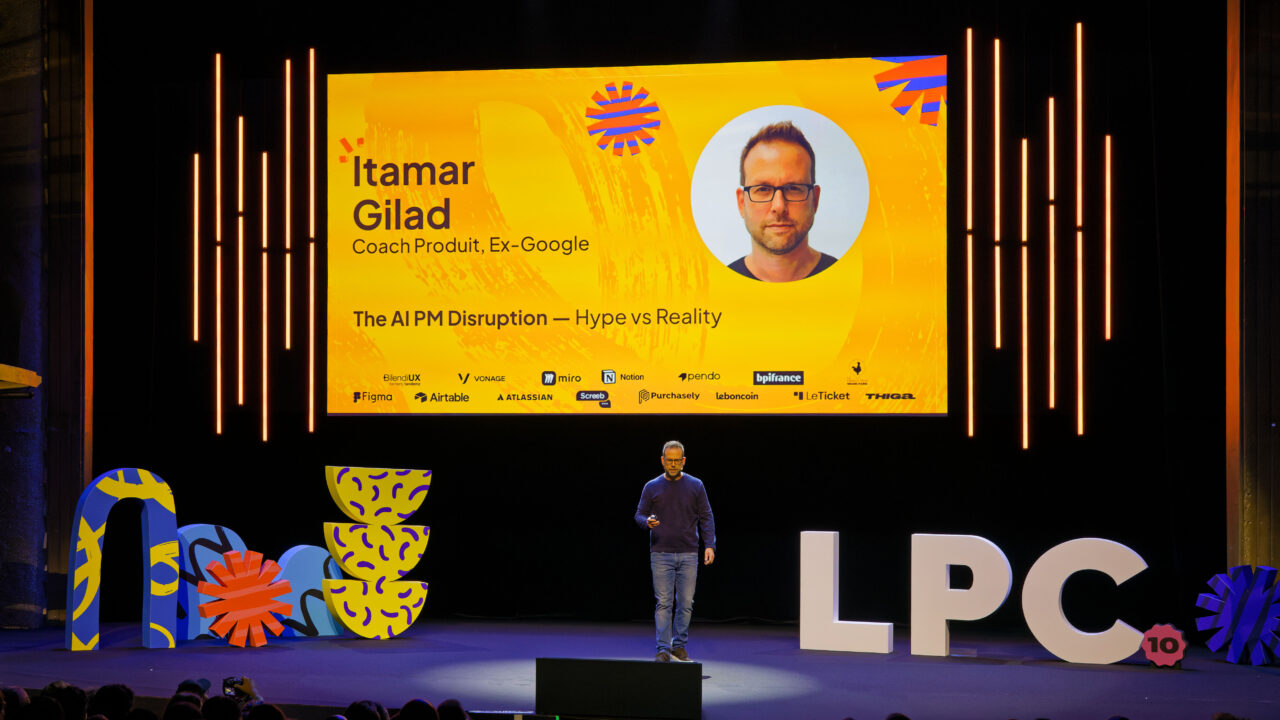
Itamar Gilad, product coach and author of Evidence-Guided, took the stage earlier in the morning with a more uncomfortable provocation. The question everyone in the room was quietly asking “will AI replace product managers?” wasn’t the right question, he argued. The right question was: what kind of product manager are you?
Gilad’s framework is blunt. Most companies, he said, operate as execution machines: strong hardware, weak software. No clear strategy, no proper research, no goals that anyone can actually measure. These companies are about to discover that AI doesn’t fix their operating model. It accelerates it. “If you have a feature factory today,” he said, “you’ll have a feature factory on steroids tomorrow, thanks to AI.”
The modern company, by contrast, treats product management as a full system: strategy, discovery, delivery, measurement, go-to-market. It uses AI to strengthen each part rather than automate the dysfunction. The distinction, Gilad argued, will separate the companies that survive the next five years from those that don’t.
His call to action was direct: stop thinking backwards from the technology. Start from what the company actually needs to achieve, and ask how AI helps get there.
The 80-20 cliff
Aiden Blake, Head of Startup Sales EMEA at Anthropic, described something he’s been watching across European startups: a pattern so consistent it now has a name. He calls it the 80-20 cliff.
Most teams can get AI to do 80% of almost anything — write the brief, draft the roadmap, prototype the feature. The remaining 20% is where companies fall apart. Not because the models aren’t capable, but because that last stretch requires something AI doesn’t have: domain judgment, taste for what matters, and the organizational trust to make a call.
The companies that get past it, Blake observed, are the ones that don’t just apply AI to their existing processes. They redesign the processes entirely. “I’ve seen companies celebrate the fact that they could now complete their twelve-step process twenty percent faster,” he said. “But you still have a twelve-step process.”
Blake’s read on Europe was cautiously optimistic. Anthropic’s four priority markets in EMEA are London, Paris, Berlin, and Stockholm — and he described what’s happening in Sweden in particular as a genuine shift. Spotify and Klarna established the benchmark; a new generation of companies like Lovable and Lugora are now building on top of it at a pace that would have seemed implausible two years ago.
Trust, he said, remains Anthropic’s non-negotiable differentiator. The company had a trust and safety team before it had a product. In an environment where enterprise clients are asking hard questions about data governance and model training, that sequence matters.
Clarity is the job
Arne Kittler, an independent product advisor, offered the session that felt most immediately useful — and most underrated.
His argument was structural. Product managers operate across four layers of clarity: directional (where are we going), situational (what’s happening right now), role (who does what), and communication (does anyone actually understand what you mean). Most teams have gaps in all four, and spend enormous energy managing the consequences — late surprises, slow decisions, unresolved conflicts.
In an AI world, Kittler argued, these gaps become critical. “If you’re not able to answer these questions to a human colleague, you will run into the exact same problems with AI,” he said. The context that good product management requires — the why behind an initiative, the hypothesis being tested, the definition of success — is also the context that AI needs to be useful.
His closing line landed harder than it might seem: “In a world where the ability to create clarity is not just helpful — it’s the most valuable thing we bring to the table.”
From head chef to truffle hunter
Back to Killeen, and the metaphor he’s replacing his old one with. In a kitchen where AI generates unlimited ideas, being the head chef isn’t enough. The new job is being outside in the forest, pattern-matching across the entire ecosystem, spotting signals before they become obvious, finding the raw material worth bringing back. He calls it truffle hunting.
To do it at scale, Killeen built himself a personal AI operating system, a system of agents that scours GitHub repositories overnight, monitors competitive help pages, synthesizes market signals, and delivers a prioritized briefing every morning. Not a productivity hack. A fundamental change in operating model.
The playbook he outlined: out-hunt the market, bend the system to fit how you actually work, then prove customer impact with evidence. What stayed with me after leaving the Folies Bergère wasn’t any single talk. It was the convergence.
Four speakers, four different angles, one conclusion: the product manager’s job isn’t disappearing. It’s being stress-tested. The PMs who survive, and the companies they work for, will be the ones who stopped hiding behind execution and started owning clarity, judgment, and the courage to redesign how work actually gets done.
Taste may be dead. But discernment, the harder, rarer thing, is more valuable than ever.