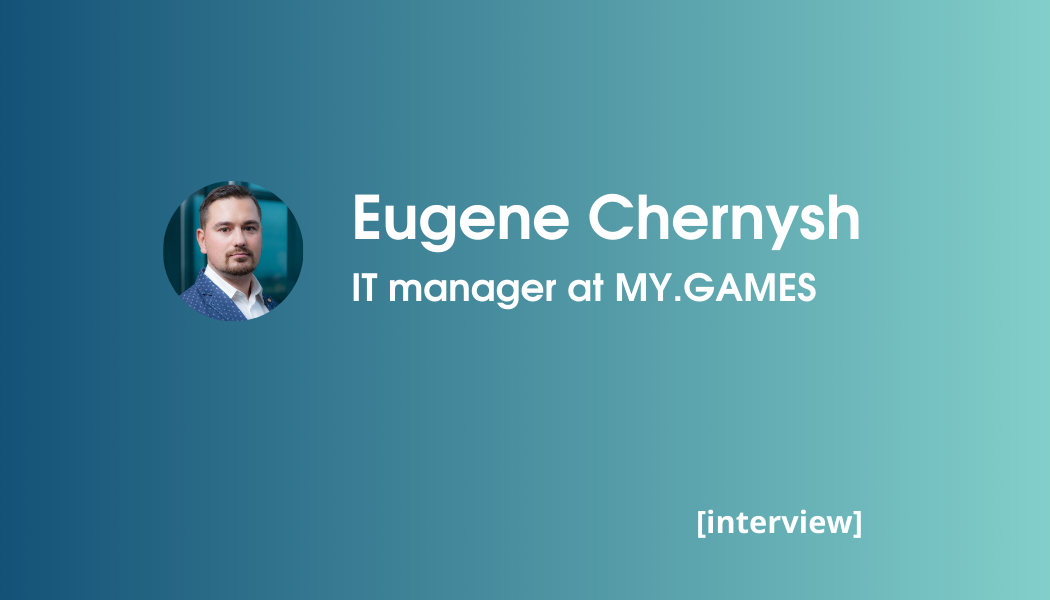
Eugene Chernysh is an experienced IT leader specializing in strategy, development, and operations, with a career spanning some of the most impactful tech companies. He currently serves as IT Manager at MY.GAMES, a leading gaming brand known for its extensive portfolio of over 150 titles, including hits like “War Robots” and “Hustle Castle” that boasts a user base exceeding a billion users globally. Previously, Eugene was the Head of Maps at VK (formerly Mail.ru Group), a dominant player in the Russian-speaking internet market, and led B2B operations at MAPS.ME, a top travel app. His roles at these organizations underscore his expertise in scaling digital products that directly serve millions of users, showcasing his leadership in navigating both operational complexity and strategic product development.
— You have conducted a tremendous amount of work on the mapping service that is now known as VK Maps. You developed it from its beginnings as MAPS.ME, guiding its transformation and growth. How has this project evolved over time, and what was your role?
— Firstly, I would like to clarify a minor point: VK Maps is a new project and is not a continuation of MAPS.ME, which was sold to new investors in autumn 2020. The only commonality between the two projects is their foundation on open data from OpenStreetMap.
The VK Maps project officially launched in October 2020. Leveraging our extensive expertise in geo, we rapidly assembled a team of over 30 highly motivated professionals. In less than 6 months we successfully launched a comprehensive geoservices package for commercial use in the b2b segment. This package includes address and point-of-interest search, logistics services, and map display services for both web and mobile devices.
My personal achievements include leading the project from inception to launch, organising the implementation of innovative algorithms and using OpenStreetMap data to reduce costs. I also ensured that the project was delivered on time and on budget, resulting in a high quality product that met and exceeded management expectations.
— Can you describe the pivotal decisions you have made to ensure product success?
— Overall, my strategic vision, innovative problem-solving, and the team’s unwavering commitment to excellence were pivotal in the successful launch and continuous enhancement of VK Maps geoservices. I am incredibly proud of our achievements in the highly competitive Russian geoservices market and deeply grateful to every team member for their dedication to this ambitious project.
A key decision that significantly boosted the project’s appeal at the company management level was opting not to purchase expensive geoservices from other providers. By transitioning VK projects to our own geoservices, we not only realized substantial cost savings but also expanded the integration of geoservices in VK’s products, thereby enhancing user experience.
— You now work at MY.GAMES, a video game publisher and developer with over a billion players worldwide. How is this niche different from what you had been doing before?
— Transitioning to MY.GAMES from my previous roles at VK Maps and MAPS.ME has certainly been an exciting shift. While my prior experience was focused on mapping technologies and B2B services, the fundamental principles of product development, user experience, and scaling operations remain constant. In the case of MY.GAMES, the scale is even larger, with over a billion players globally, meaning the stakes are higher in terms of user engagement, infrastructure, and operational complexity.
One key difference is the nature of the product. Maps and navigation tools cater to utility and practical use cases, where functionality and precision are paramount. In contrast, gaming is an entertainment-driven industry where user immersion, engagement, and community building play critical roles. The technology stack and infrastructure I manage must support not just functionality, but also real-time multiplayer experiences, seamless content delivery, and continuous updates for a diverse, global player base.
That said, my previous roles have equipped me with a strong foundation in managing high-traffic platforms, optimizing performance, and leading cross-functional teams—all of which are essential in my current role at MY.GAMES.
— What are the specifics of the functions of an IT manager in a game development company? How would you describe your goals and mission in this role?
— In general, the core functions of an IT manager in a game development company are quite similar to those in other IT-driven organizations. When we abstract away from the specifics of game development, games are ultimately digital products, much like any other in the IT industry. The primary responsibility is to establish and maintain an efficient IT environment that supports the needs of product teams.
This involves creating a robust and highly available infrastructure that ensures seamless operation. From communication tools like email and messaging platforms to task management systems and development environments, the IT department plays a pivotal role in enabling teams to collaborate and work efficiently. Additionally, it provides key services for company operations, such as systems for managing workflows, resources, and performance analytics to evaluate the success of released products.
In essence, the mission is to ensure that the technical foundation is solid, secure, and adaptable to both the current needs and future growth of the company, enabling development teams to focus on innovation and creativity without technical hindrances.
— How do you utilize novel technologies to streamline operations and enhance coordination within the company?
Our company develops over 150 games, with numerous teams dedicated to creating intricate graphic content. To enhance their productivity, speed, and quality, we implemented an AI-powered system for generating graphical content. This system allows for the training of customized AI models, ensuring precise and relevant outputs for each unique game title.
Unlike other solutions, our AI models are trained specifically for individual game titles, ensuring high relevance and precision in the generated graphics.
The initial implementations across several game titles have demonstrated the enormous potential of this solution. It has boosted designers’ productivity by more than 4 times, showcasing its effectiveness.
— Looking ahead, how do you think emerging technologies will impact the areas of IT management, business development, and operations in the next five years?
— I believe we are currently at a pivotal point in the development of technology, where many industries will undergo significant changes, and undoubtedly, technology will exert considerable influence on IT management, business development, and operational activities. Primarily, this transformation will be driven by the active growth of AI and ML, which will enable the automation of routine operations and improve the quality of predictive analytics. This, in turn, will lead to reduced operational costs and increased business efficiency, partly by reducing decision-making time.
Naturally, working with Big Data and analytics will allow companies to gain deeper insights into their customers, develop a more precise understanding of customer behavior, and track market trends, all of which will positively affect the quality and speed of decision-making, ultimately leading to better business performance. Another ongoing trend is the shift from standalone solutions deployed on proprietary server capacities to hybrid and cloud environments and solutions. This transition enhances flexibility in scaling both services and the company as a whole.
We should not overlook AR and VR technologies either. While many still perceive these as novelties, there are already numerous examples where AR and VR not only aid in business development—enabling customers to experience a product virtually without leaving home—but also improve employee experience in traditional fields. For instance, in medicine, AR and VR assist in surgeries, and in construction, they help professionals interact with 3D objects on real sites.
The benefits of new technologies are vast, but it is crucial to act now and begin integrating them into business operations. Companies that actively adopt these technologies will be able to secure leading positions in their industries, ensuring growth and creating unprecedented value for both customers and employees.