
The next major breakthrough in financial technology may be something customers never see. As banks introduce AI agents, embed financial services into other platforms and connect payment systems across borders, the greatest challenges increasingly lie beneath the interface: infrastructure that can move money reliably, make decisions responsibly and verify who is authorized to act.
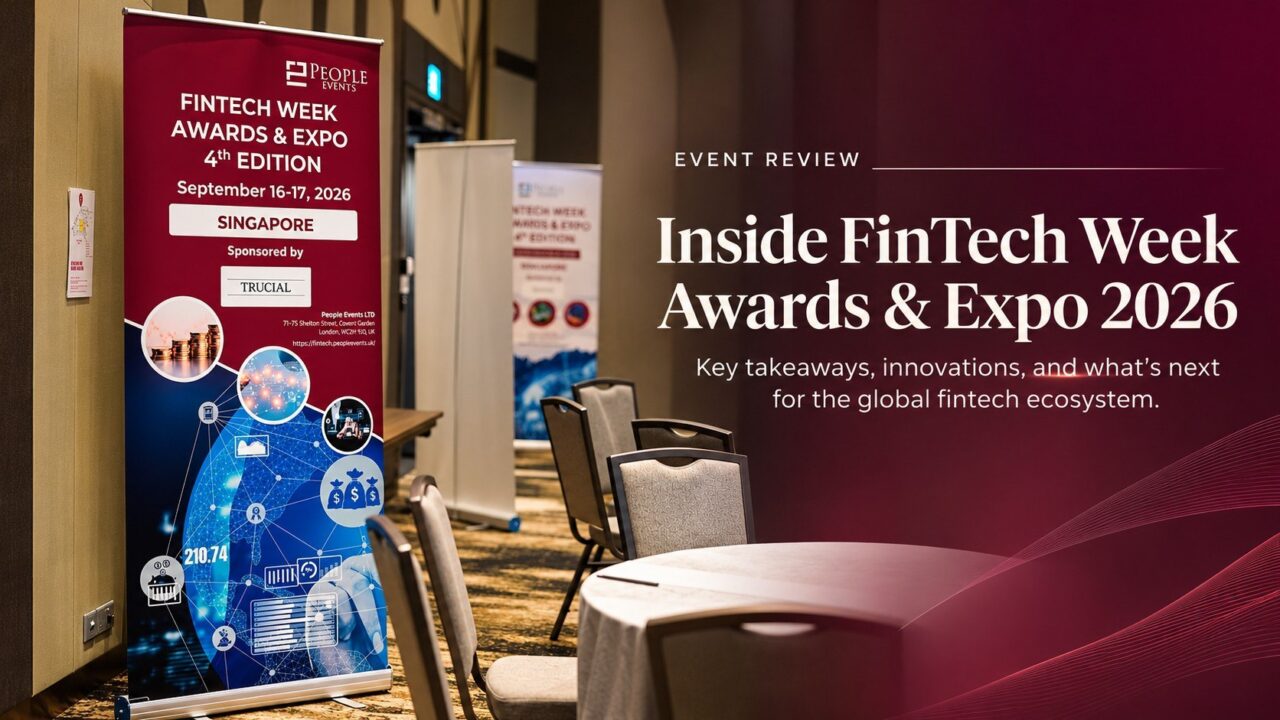
That shift was central to the program of the 4th FinTech Week Awards & Expo Singapore 2026, held on September 16–17 at Crowne Plaza Changi Airport.
Organized by The People Events, the conference attracted more than 70 speakers and delegations from over 30 countries, connecting technology founders, banking executives, investors and financial infrastructure specialists.
For an industry long associated with disruptive apps, the event pointed toward a different competitive battleground: the systems that make financial services work.
Infrastructure Becomes the Real Growth Engine
Vadim Timokhin, Founder and CEO of XChangeLab, opened the program with a keynote on unified infrastructure for global financial operations. Laksh Gangwani, Chief Growth Officer of ViewTrade, reinforced this direction through his presentation on infrastructure as fintech’s next growth engine.
An attractive interface can attract customers, but sustainable growth depends on the systems processing transactions, reconciling accounts and maintaining regulatory compliance.
Singapore is investing in this layer. On August 31, the Monetary Authority of Singapore (MAS) committed S$220 million over three years through its renewed Financial Sector Technology and Innovation Scheme.
Singapore hosts more than 1,800 fintech companies employing nearly 10,000 professionals, with sector investment reaching S$2.9 billion in 2025.
For founders, the implication is significant: customer acquisition matters, but controlling infrastructure costs and maintaining operational reliability are equally important to profitability.
AI Moves Beyond Chatbots Into Financial Decisions
Artificial intelligence featured throughout the program, with David B. Wang, Adriel Wong, Ankit Lathigara and Anndy Lian examining autonomous finance.
Thomas Nokin addressed banking’s readiness for AI adoption, while Kevin Lee, Prabujati Adistya and Dr. Simon Liu explored applications involving credit underwriting, capital markets and risk management.
These applications introduce a fundamental engineering distinction. Generating an answer is different from authorizing a financial action.
MAS addressed this challenge through its July 2026 Safeguards for Agentic Finance at Runtime framework, which proposes governance checkpoints to verify and record proposed AI-agent actions before execution.
Its earlier AI Risk Management Toolkit, developed with 24 financial institutions and industry partners, provides practical resources for managing risks across conventional, generative and agentic AI.
AI adoption in finance is becoming an infrastructure and governance challenge—not simply a competition over model performance.
Asia’s Payment Networks Face an Interoperability Test
Cross-border payment discussions featured Aaron Sim, Nor Kamil Ahmad Zukni, Pravin Sharma, Kiran Sharma and Windham Zhang.
Connecting financial systems across currencies and jurisdictions requires common technical standards, reliable settlement arrangements and institutional cooperation.
The Bank for International Settlements’ Project Nexus demonstrates this direction. In 2025, central banks from India, Indonesia, Malaysia, the Philippines, Singapore and Thailand established Nexus Global Payments to advance the integration of domestic instant-payment networks.
A shared platform could reduce the need for separately engineered connections between participating markets, although foreign-exchange pricing, fraud prevention and settlement reliability remain essential.
Digital Assets and Identity Meet Institutional Requirements
Chee Keong Teo, Oliver von Wolff, Yiannos Ashiotis, Doreen Fadli, Avalon Ingram and Amos Song explored tokenization as financial infrastructure.
Singapore’s Project Guardian provides a practical industry backdrop, supporting cross-border experimentation involving tokenized financial instruments and interoperable settlement systems.
However, MAS Managing Director Chia Der Jiun acknowledged in October that meaningful commercial adoption remained largely concentrated within smaller ecosystems.
Digital identity presents a similar challenge. As financial services become embedded in third-party applications, authentication, permission management and continuous risk monitoring must extend beyond initial customer onboarding.
FinTech Week Awards Recognize Innovation and Industry Leadership
Beyond its technical discussions, the Singapore edition celebrated contributions to financial technology through the FinTech Week Awards ceremony.
The recognition program honored emerging startups, established financial institutions and industry leaders for their achievements in technological innovation and financial services.
The awards provide an additional platform for companies to demonstrate their contributions beyond product launches and fundraising announcements.
For fintech founders, industry recognition can support corporate credibility, investor communications and partnership development, particularly when entering markets where institutional trust is essential.
Such recognition, however, complements rather than replaces the commercial and technical evidence needed to demonstrate a solution’s effectiveness.
FinTech Week Awards & Expo Heads to Dubai in 2028
Looking ahead, the seventh edition of the FinTech Week Awards & Expo is scheduled for March 7–8, 2028, in Dubai, under the theme “Payments Automation & Security”.
The upcoming event will examine AI-enabled financial services, digital banking, embedded finance, decentralized technologies, open finance and regulatory innovation.
Its 2028 Recognition Program will recognize achievements in fintech innovation and leadership. According to the organizers, nominations will undergo confidential evaluation by a research team and independent judges.
Award recipients will receive a Certificate of Excellence, an official trophy, a digital award badge, a customized company profile, promotional opportunities and media exposure.
Organizations interested in participating can submit their nominations through the official FinTech Week Awards application portal.
The Dubai edition extends the infrastructure-focused conversation highlighted in Singapore, placing payment automation and security at the center of financial innovation.
Ultimately, the next generation of successful fintech companies may not be those with the most visible applications, but those capable of building the dependable, intelligent and secure financial infrastructure that everyone else relies on.