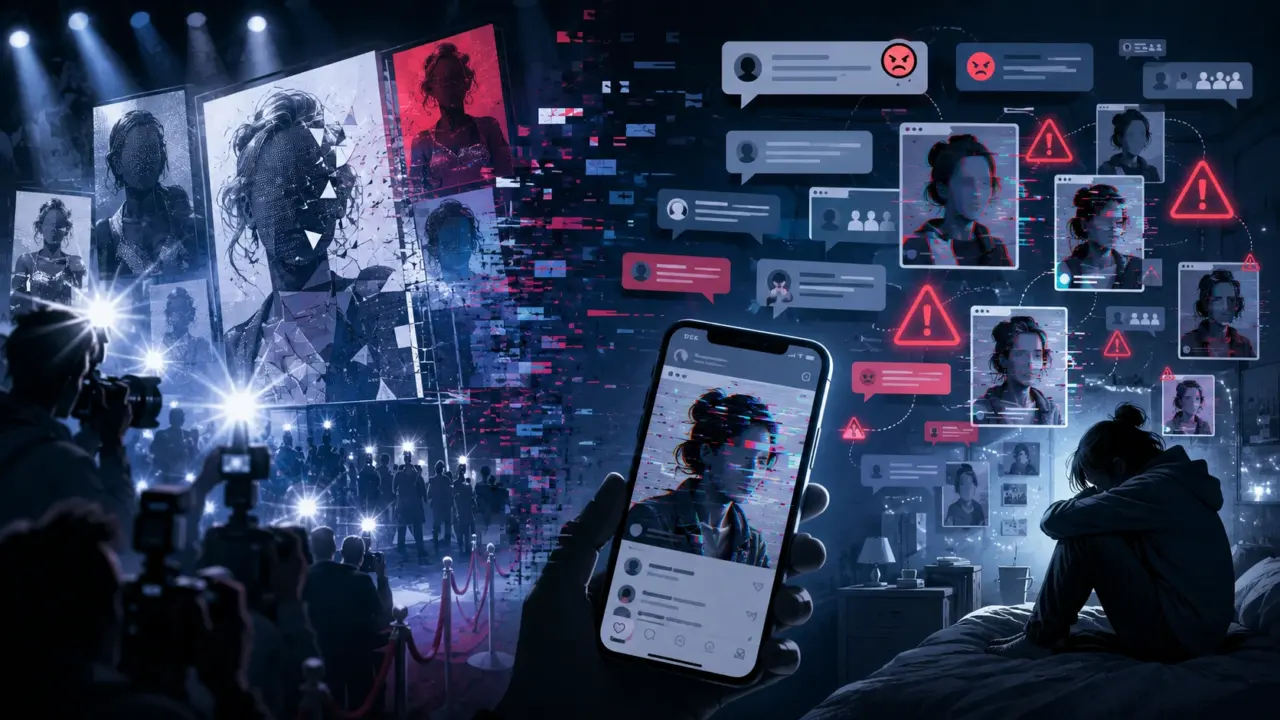
For a long time, people thought deepfakes were only a problem for celebrities. Most of the public saw them in viral scandals, fake political videos, or shocking hoaxes involving well-known faces. But that view is outdated. Now, artificial intelligence has brought deepfake abuse into everyday life—into schools, classrooms, student chats, and the lives of young people who never expected to be targeted.
The shift is dangerous because the victim no longer needs to be a celebrity. A simple photo from a social media account, a school activity, or a private message can now be misused to create a fake image that appears intimate, embarrassing, or damaging. Researchers studying non-consensual synthetic intimate imagery describe this harm as fabricated or manipulated sexual content made without a person’s consent.
This means deepfakes are no longer just about public scandals. What used to be a problem for actors, influencers, and politicians is now a type of bullying that can hurt students, teachers, and regular families.
From Famous Faces to Ordinary Students
Deepfake technology first became known because it targeted public figures. Celebrities and politicians were easy targets since their photos were everywhere online. Now, though, these tools can be used against anyone, even if they only have a few photos online.
This shift is important because school bullying often spreads quickly and relies on embarrassment and peer pressure. A fake image doesn’t have to go viral to cause real harm. In a school, it might only need to be shared in one group chat, among friends, or within a local community to hurt a student’s reputation and emotional well-being.
A RAND Corporation report on deepfakes in K–12 schools found that 13 percent of surveyed school principals reported bullying incidents involving AI-generated deepfakes during the 2023–2024 and 2024–2025 school years. The same report showed that the problem was more common in older students, with 22 percent of high school principals and 20 percent of middle school principals reporting incidents, compared with 8 percent of elementary school principals.
These numbers show that deepfake bullying is not just a distant tech problem anymore. It is already showing up in school discipline cases, student safety talks, and worries from parents.
Why Fake Images Can Cause Real Harm
Traditional cyberbullying usually involves insults, rumors, screenshots, or real photos shared without permission. Deepfake bullying with AI is even more complicated because it can create fake images of things that never happened, but still make the victim feel exposed.
The RAND report noted that students can use AI tools to create false and inappropriate images or videos of classmates and school staff. This is especially serious because old online safety advice no longer fully protects students. A young person may never send an intimate photo, but still become the subject of one created by AI.
The harm does not go away just because the image is fake. Victims can still feel shame, be teased, become isolated, or have to explain that the image is not real. Often, they have to defend themselves against something they did not make or choose.
A Thorn press release on youth and AI-generated deepfake nudes reported that roughly one in ten minors said they knew of cases where friends or classmates created synthetic non-consensual intimate images, or “deepfake nudes,” of other children using generative AI tools. Thorn described this as an evolution in how child sexual abuse material can be produced and shared, and as a new weapon in bullying.
The Technology Became Easier to Misuse
One reason deepfakes have shifted from celebrity scandals to everyday bullying is easier access. In the past, making a convincing fake image or video took advanced technical skills. Now, generative AI tools have made it much simpler.
A 2025 study titled “Deepfakes on Demand” found nearly 35,000 publicly downloadable deepfake model variants across two major online repositories, mostly hosted on Civitai. The researchers also found that these models had been downloaded almost 15 million times since November 2022.
The same study reported that 96 percent of the models it reviewed targeted women, with many connected to the creation of non-consensual intimate images. It also found that some deepfake model variants could be trained using as few as 20 images, a short training period, and consumer-grade computing equipment.
This is why the issue has become more urgent. AI image systems do not simply edit one picture. They learn visual patterns and generate new images that may look believable even when they are entirely false. When used maliciously, that technical capability can turn an ordinary school photo into a tool for harassment.
Schools Are Being Forced to Respond
The movement of deepfakes into student life creates difficult questions for schools. A single incident may involve bullying, sexual harassment, digital evidence, privacy violations, child protection, school discipline, and possible law enforcement referral.
According to the RAND school survey, among schools that experienced deepfake-related incidents, 79 percent took disciplinary action, 66 percent referred the matter to law enforcement, and 47 percent provided training or educational support to students and staff. However, only 23 percent of schools updated their policies to specifically address AI misuse.
That policy gap is significant. Many school handbooks already prohibit bullying and harassment, but they may not clearly explain what happens when a student creates a fake AI image, shares it through a private messaging app, or uses an external tool outside school property.
Schools also face a sensitive reality when both the victim and the offender are minors. Accountability is necessary, but so are education, rehabilitation, victim protection, and clear reporting procedures. Treating deepfake abuse as a joke can worsen the harm, especially when the victim’s reputation and mental health are affected.
The Law Is Beginning to Catch Up
Legal systems are starting to recognize that synthetic images can cause real harm. In the United States, the TAKE IT DOWN Act was signed into law on May 19, 2025, and covers both real non-consensual intimate images and AI-created digital forgeries.
The National Association of Attorneys General explained that covered online platforms must provide a reporting process for non-consensual intimate content and remove qualifying material, including identical copies, within 48 hours after a valid request. The same analysis noted that enforcement of this notice-and-removal requirement belongs to the Federal Trade Commission.
The National Center for Missing & Exploited Children said the law applies to the publication of real or digitally fabricated intimate images of minors when the intent is to abuse, humiliate, harass, or degrade them. NCMEC also connected the law to broader risks such as online bullying, harassment, sextortion, and child exploitation.
Still, legal remedies do not remove the entire burden from victims. A student may not know where an image has been posted, how many people saved it, or which platform should receive the report. Even with a law in place, the victim often has to act quickly during a moment of fear and confusion.
Platforms Remain a Weak Link
Platform response is critical because deepfake images can spread across social media, private messages, anonymous accounts, cloud folders, and screenshots. Removing one copy does not always remove every version.
A 2024 audit study on reporting non-consensual intimate media tested how X, formerly Twitter, handled takedown reports by uploading 50 AI-generated nude images and reporting them under different categories. The researchers found that copyright complaints led to removal within 25 hours for all reported images, while reports filed as non-consensual nudity did not result in removal for more than three weeks.
That finding shows a troubling imbalance. If a platform reacts faster to intellectual property claims than to intimate image abuse, victims of deepfake bullying may remain exposed during the most damaging period of circulation.
This is why platform accountability cannot depend only on ordinary user reporting. Companies need clearer reporting channels for minors, faster escalation systems, stronger detection tools, and policies that specifically recognize AI-generated intimate abuse as a safety issue.
The Real Crisis Is Trust
The rise of deepfake bullying shows that the problem has moved far beyond celebrity gossip. It is now about whether ordinary people can trust that their photos will not be turned against them.
For students, the harm can continue even after an image is removed. They may worry that the image will resurface, that classmates will still believe it, or that adults will not understand how quickly the damage spreads. For parents and teachers, the issue can be difficult to manage because the abuse may begin in a private online space but quickly affect school life.
The response must therefore go beyond punishment. Schools need AI-specific policies, digital literacy lessons, clear reporting protocols, and victim support systems. Parents need guidance on how to respond without blaming the victim. Platforms need faster and more serious takedown procedures. Lawmakers need to continue recognizing that synthetic abuse can create real-world harm.
AI deepfakes are no longer just a celebrity scandal problem. They have entered the everyday spaces where young people study, socialize, and build their identities. A fake image may be digitally manufactured, but the humiliation, fear, and accountability questions it creates are very real.