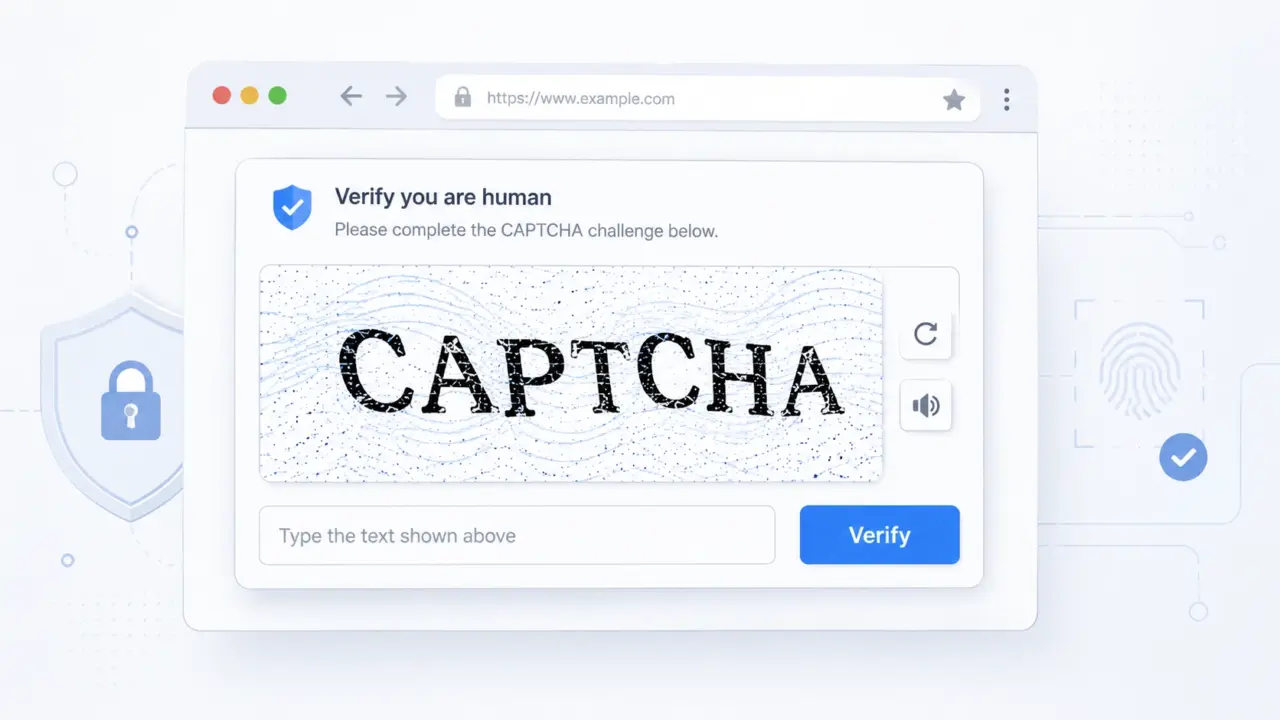
CAPTCHA began as a clever defense against bots, but it slowly became one of the internet’s most irritating rituals. It asks users to prove they are human by reading distorted text, clicking traffic lights, identifying buses, solving puzzles, or simply waiting while a website silently judges their behavior.
The official CAPTCHA site describes a CAPTCHA as a program that protects websites against bots by generating and grading tests that humans can pass but current computer programs cannot. That simple idea explains why CAPTCHA spread so widely: websites needed a cheap way to separate real people from automated abuse.
In the original paper “CAPTCHA: Using Hard AI Problems for Security”, researchers Luis von Ahn, Manuel Blum, Nicholas Hopper, and John Langford introduced CAPTCHA as an automated test that humans could pass but computer programs could not.
At the time, the concept was elegant. Instead of fighting bots with passwords or manual moderation, websites could use a task that depended on human perception. The problem is that what works as security can become exhausting when repeated millions of times across the web.
Why bots made CAPTCHA necessary
CAPTCHA became important because the internet created new opportunities for automated abuse. Bots could create fake accounts, post spam comments, scrape content, buy tickets, stuff online polls, or attack login pages faster than human moderators could respond.
The research paper “A Study of CAPTCHAs for Securing Web Services” explains that malicious web bots pose a threat to online services that assume human interaction, which is why websites use Human Interaction Proofs to confirm that the user is not a bot.
This is the scientific reason behind CAPTCHA’s existence. It is not mainly about annoying users. It is about forcing a machine to solve a task that is easy for people but difficult for automation.
Early CAPTCHAs often relied on distorted letters because humans could recognize warped text better than optical character recognition software. But as machine learning improved, bots became better at solving the same tests. That created an arms race: CAPTCHAs became harder, users became more frustrated, and attackers kept adapting.
From distorted words to unpaid labor
CAPTCHA’s story became more interesting with reCAPTCHA, which turned security tests into useful work. Instead of showing random distorted letters, reCAPTCHA used words from scanned books and newspapers that computers had difficulty recognizing.
In the Science paper “reCAPTCHA: Human-Based Character Recognition via Web Security Measures”, the authors explained that CAPTCHAs are widespread security measures that prevent automated programs from abusing online services.
The same reCAPTCHA paper described a system that channels human effort from security tests into the digitization of old printed materials. In other words, users were not only proving they were human; they were helping computers read difficult text.
This made reCAPTCHA one of the most unusual examples of crowdsourcing on the internet. A person trying to sign in, comment, or download something might also be helping decode a word from an archive. The test was annoying, but it had a larger purpose.
However, that also changed how people thought about CAPTCHA. It was no longer just a gatekeeper. It became a system that extracted small pieces of human labor in exchange for access.
The usability problem was built in
CAPTCHA is annoying because it interrupts the user’s goal. A person visits a website to log in, buy a ticket, send a message, or submit a form. CAPTCHA suddenly adds a separate task that may feel unrelated to the reason they came.
The annoyance grows when the task is unclear. Users may not know whether a traffic light includes the pole, whether a crosswalk includes a tiny corner of paint, or whether a blurry character is a “g” or a “q.” The test may be easy for some users and difficult for others.
The study “Making Defeating CAPTCHAs Harder for Bots” notes that attackers have found ways to circumvent CAPTCHAs by programming bots to solve or bypass them, or even relaying them for humans to solve.
That creates a design trap. If the CAPTCHA is too easy, bots may defeat it. If it is too hard, real users fail or abandon the page. CAPTCHA therefore lives in a narrow space between security and frustration.
Accessibility made CAPTCHA more controversial
CAPTCHA’s biggest weakness is not just inconvenience. It can exclude people.
The W3C note on CAPTCHA inaccessibility warns that a CAPTCHA without an accessible and usable alternative can make it impossible for some users with disabilities to create accounts, write comments, or make purchases.
This is a serious issue because CAPTCHA often asks users to complete visual or audio tasks. A visual CAPTCHA may be difficult for blind or low-vision users. An audio CAPTCHA may be difficult for deaf or hard-of-hearing users, non-native speakers, or people in noisy environments.
The W3C also explains that such tests can fail to recognize users with disabilities as human, obstructing participation in contemporary society. That is why CAPTCHA is not only a cybersecurity topic. It is also a digital rights and accessibility issue.
A security system that blocks bots is useful. But if it also blocks legitimate users, it becomes part of the problem it was supposed to solve.
The rise of invisible CAPTCHA
Modern CAPTCHA systems have shifted away from distorted text and toward risk scoring. Instead of always asking users to solve a visible puzzle, newer systems analyze behavior, context, and interaction signals to estimate whether a request looks human or automated.
Google’s reCAPTCHA v3 documentation says the system returns a score, where 1.0 is very likely a good interaction and 0.0 is very likely a bot.
This approach reduces visible friction because websites can take action behind the scenes. A low-risk user may pass without seeing anything. A higher-risk user may face extra verification.
But invisible CAPTCHA also raises new questions. If a website is judging users through behavior, device patterns, or interaction signals, users may not fully understand why they were challenged or blocked. The irritation becomes less visible, but the power of the system becomes more hidden.
A 2019 study called “Hacking Google reCAPTCHA v3 using Reinforcement Learning” found that a reinforcement learning method achieved a 97.4% success rate on a 100×100 grid and 96.7% on a 1000×1000 screen resolution in its experimental setting.
That finding shows the same old arms race in a newer form. As CAPTCHA becomes smarter, attackers also test smarter ways to defeat it.
The AI problem CAPTCHA helped predict
CAPTCHA was built on a simple assumption: some tasks are easy for humans and hard for machines. That assumption has weakened over time because artificial intelligence has improved at image recognition, speech recognition, text generation, and behavior imitation.
This is the irony of CAPTCHA. It used hard AI problems to protect websites, but AI progress slowly made those problems less hard. The better machines became at reading images, identifying objects, and mimicking human behavior, the more CAPTCHA had to evolve.
That is why CAPTCHA feels more annoying today. It is not only a test of whether the user is human. It is a sign that the boundary between human and machine behavior online has become harder to detect.
The internet’s most familiar inconvenience
CAPTCHA became the internet’s most annoying security test because it sits at the exact point where security meets human patience. It protects websites from bots, but it also turns ordinary users into temporary suspects.
Its history shows the challenge of modern web security. A good system must stop automation, preserve privacy, remain accessible, reduce friction, and still work against attackers who are constantly improving.
That is difficult to achieve in one small box.
CAPTCHA may continue to evolve into invisible scoring, device-based checks, cryptographic proof, or new forms of authentication. But its cultural reputation is already fixed. It is the test everyone understands, everyone complains about, and almost everyone has had to complete.
In the end, CAPTCHA became famous not because it was perfect, but because it made one of the internet’s biggest problems visible: proving humanity online is surprisingly hard.