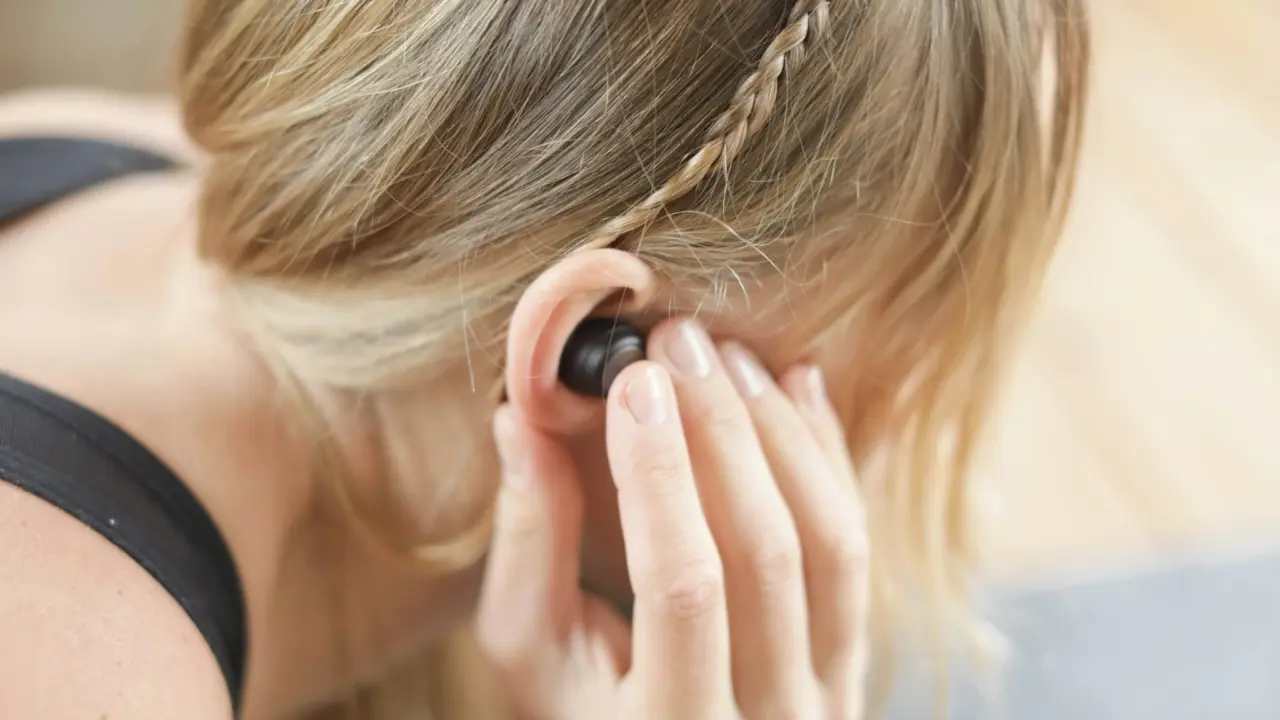
The device in someone’s ears may increasingly be difficult to classify.
Wireless earbuds were built for music, calls and noise cancellation. But newer consumer audio products can now test hearing, adjust amplification to an individual audiogram, make conversation easier to hear and reduce exposure to loud environmental sound. Some have crossed an even more significant boundary: regulators now recognize software running on ordinary consumer earbuds as hearing-aid technology.
That shift matters because hearing loss is hardly a niche medical problem. The World Health Organization estimates that 1.5 billion people worldwide live with some degree of hearing loss, including about 430 million who require rehabilitation services. That total could reach 2.5 billion by 2050.
Consumer audio is therefore entering a healthcare market measured not only in devices sold, but in people whose ability to communicate can depend on how well sound is processed.
Mild hearing loss is more than turning up the volume
Hearing loss is frequently described in decibels, but the experience is more complicated than sounds simply becoming quieter.
A 2026 Cochrane review defines mild hearing loss as average pure-tone thresholds of 20 to less than 35 decibels hearing level, with moderate loss ranging from 35 to less than 50 dB HL. Mild loss can make soft sounds and conversation in noisy environments difficult to hear, while moderate loss can interfere with speech even in quieter settings.
The same review notes that hearing problems can also involve temporal and spectral processing deficits that are not necessarily captured by pure-tone audiometry. That helps explain why two people with similar audiograms can experience very different difficulty understanding speech.
Speech in noise is particularly challenging because a hearing device must do more than make everything louder. Increasing both a speaker’s voice and surrounding restaurant noise by the same amount may leave the underlying problem unchanged.
Modern hearing aids therefore use technologies including directional microphones, frequency-dependent amplification, dynamic-range compression and noise reduction to make useful sounds more accessible.
A review of hearing-aid technology notes that difficulty understanding speech in noise is one of the primary reasons people seek hearing assistance, yet many hearing-aid users continue to struggle with noisy environments even after amplification.
Consumer earbuds are beginning to perform the same tasks
The boundary shifted considerably when the U.S. Food and Drug Administration authorized Apple’s Hearing Aid Feature in 2024.
The FDA classified it as the first over-the-counter hearing-aid software device intended for compatible AirPods Pro headphones. Once configured, compatible AirPods can function as OTC hearing aids for adults with perceived mild-to-moderate hearing impairment.
The feature uses a self-fitting approach. Hearing levels stored through Apple Health are used to personalize amplification, while users can further adjust volume, tone and balance.
The FDA’s clinical evaluation involved 118 participants with perceived mild-to-moderate hearing loss. It found that people using the self-fitting approach achieved similar perceived benefit to participants who received professional fitting of the same device, with comparable results for amplification in the ear canal and speech understanding in noise.
In the Philippines, Apple activated its hearing-health features in March 2026 for compatible AirPods Pro models, combining a self-administered Hearing Test, Hearing Aid feature and Loud Sound Reduction. The hearing test is based on pure-tone audiometry, the conventional clinical method of measuring hearing thresholds across frequencies.
Research shows earbuds can provide meaningful amplification
Independent research has increasingly examined whether consumer earbuds actually perform like hearing-assistance devices rather than simply sounding louder.
A study of 35 people with mild-to-moderate hearing loss found that AirPods Pro and a dedicated personal sound amplification product both produced higher word-recognition and sentence-recognition scores than the unaided condition. Researchers found no significant differences in functional gain between the two devices at most tested frequencies, although the AirPods showed a deviation of more than 10 dB SPL at 6 kHz in one real-ear measurement.
Earlier research comparing smartphone-bundled earphones with hearing aids similarly found that AirPods Pro showed no significant difference from hearing aids for speech perception in quiet, although performance was not equivalent in background noise.
That distinction is important. Hearing healthcare is not simply about making speech audible in a quiet room.
A 2026 study examining the AirPods Pro 2 Hearing Aid Program found that amplification changed according to both hearing profile and input level. Gain generally increased toward middle and higher frequencies and decreased as incoming sound became louder, with marked attenuation at an 80 dB SPL input level.
That is characteristic of nonlinear amplification: softer sounds may receive more gain while louder sounds are prevented from becoming uncomfortably amplified.
But researchers also found that the AirPods produced generally lower amplification and less frequency-specific variation than conventional NAL-NL2 and DSL v5 prescriptive targets. They concluded that the system appears to emphasize listening support and output control rather than strict matching to traditional hearing-aid prescriptions.
Hearing aids still have evidence that earbuds are only beginning to build
The evidence supporting conventional hearing aids remains much broader.
The updated 2026 Cochrane review analyzed 16 studies involving 2,261 adults with mild-to-moderate hearing loss and concluded that hearing aids probably produce a large improvement in listening ability and hearing-specific participation.
A separate 2026 systematic review and meta-analysis incorporated 33 randomized controlled trials and 4,471 participants, finding moderate-to-large benefits on hearing-related self-reported outcomes for hearing aids compared with no intervention or waiting-list controls.
Consumer-earbud studies are still smaller and generally examine narrower questions.
That does not make their results unimportant. It means a familiar audio product is beginning to reproduce some functions of specialist medical hardware while the clinical evidence surrounding it is still developing.
Software cannot diagnose every reason someone cannot hear
OTC technology also has a clear limit: not every hearing problem should be self-treated.
The FDA says OTC hearing aids are intended for adults with perceived mild-to-moderate hearing loss, not severe or profound impairment. It specifically advises medical evaluation for warning signs including sudden hearing changes, ear pain or discharge, severe dizziness, substantial asymmetry between ears, or ringing limited to one ear.
An audiologist can also assess more than whether a sound is audible. Clinical testing can evaluate speech understanding, the type and degree of hearing loss and whether amplification actually fits a person’s communication needs.
That distinction will remain important as consumer products absorb more medical functions.
The healthcare device may already be in your pocket
The interesting change is not that earbuds will replace hearing aids.
It is that the categories are beginning to overlap.
The same hardware can now move between entertainment, hearing protection, screening and regulated amplification largely through software. That gives consumer-electronics companies a path into healthcare without asking users to adopt an entirely unfamiliar device.
For product builders, it also illustrates a wider technology shift. Sensors and processors originally added to make everyday electronics more convenient can gradually acquire enough accuracy—and enough regulatory validation—to support health functions.
The future of consumer health technology may therefore look less like people buying another medical gadget.
It may look like devices they already wear gaining medical capabilities one software update at a time.