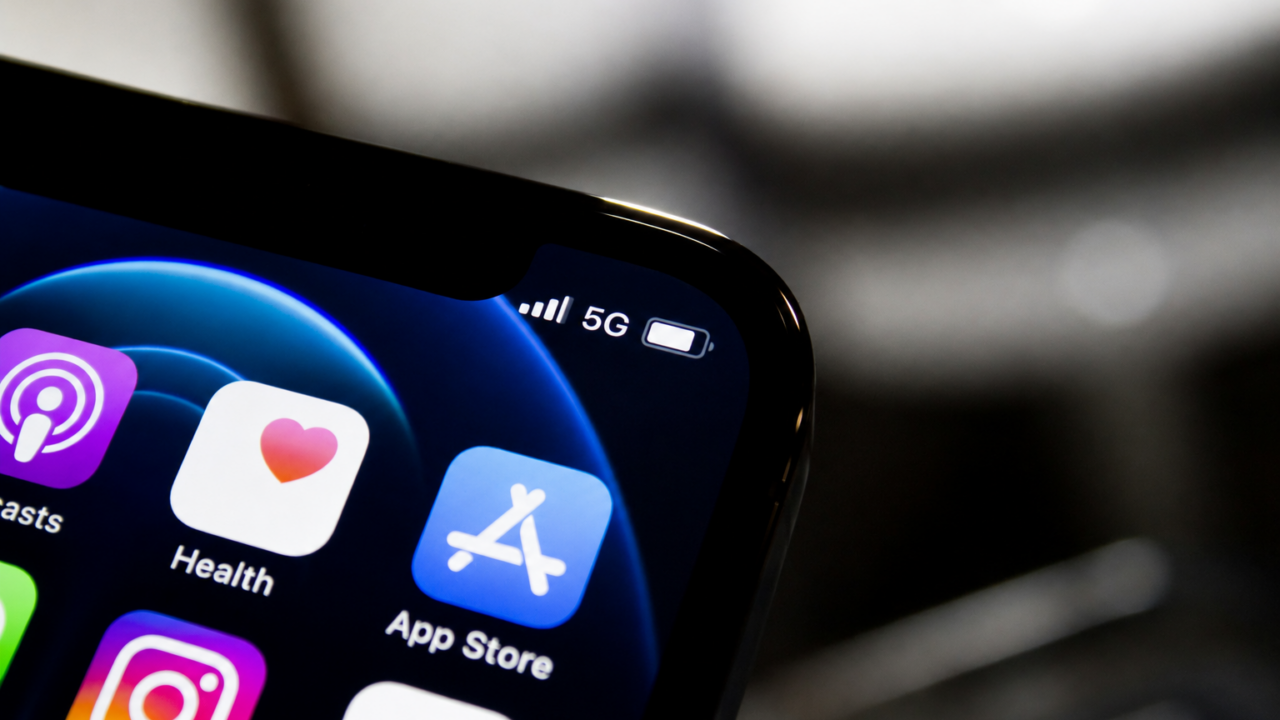
The 5G symbol appears at the top of your phone, yet Instagram takes seconds to refresh. A video drops in quality. A website hangs halfway through loading. You run a speed test and wonder why the connection that was supposed to be dramatically faster than 4G barely feels different.
The explanation starts with a simple misconception: “5G” is a network technology indicator, not a live speed measurement.
Android’s official 5G documentation distinguishes the network information shown for display purposes from the actual underlying radio configuration, including 5G Non-Standalone, or NSA, connections. In other words, seeing 5G tells you something about the cellular network available to the phone, but it does not promise a particular number of megabits per second.
Not Every 5G Connection Is the Same
One reason two phones showing “5G” can behave completely differently is that 5G operates across different frequency bands.
A large real-world study of commercial 5G networks in Chicago and Minneapolis found that deployed 5G uses both low-band spectrum below 1 GHz and mid-band spectrum between roughly 1 and 6 GHz, while earlier US deployments also relied heavily on millimeter-wave frequencies above 24 GHz.
Those frequencies involve different engineering trade-offs.
The same study found that much of 5G’s observed throughput advantage over 4G came from access to wider channel bandwidth, while better signal conditions were also necessary to fully realize higher speeds. The researchers concluded that wider channels, denser deployments, and beamforming all influence real-world performance.
Low-frequency signals can provide useful coverage over wider areas, but merely connecting to a 5G low-band network does not mean your phone suddenly has access to enormous amounts of spectrum.
At the opposite extreme, research on commercial smartphone 5G found that millimeter-wave connections can deliver exceptionally high throughput but are particularly vulnerable to obstruction, including blockage from a user’s hand or body.
So your phone can legitimately say 5G in two locations while experiencing radically different speeds.
Your 5G Connection May Still Depend on 4G
There is another complication hidden behind the icon: some 5G networks are Non-Standalone, meaning 5G works together with existing LTE infrastructure.
The 3rd Generation Partnership Project, which develops the technical standards behind 5G, explains that Non-Standalone architecture connects a 5G New Radio base station to a 4G LTE base station and uses the existing 4G core network.
3GPP has also described NSA operation as using LTE as the control-plane anchor while 5G New Radio adds capacity for user data.
That does not make NSA “fake 5G.” It means the architecture is hybrid.
It also helps explain why the symbol alone cannot describe the entire path your data is taking. Your connection can involve LTE and 5G components, changing radio conditions, different frequency bands, and infrastructure beyond the cell tower.
Full Signal Bars Do Not Mean an Empty Cell Tower
Even an excellent radio signal cannot guarantee high speed when many people are competing for the same network resources.
A 2024 experimental study examining 5G data transmission found that a network delivering around 50 Mbps under a light workload could fall to roughly 20–30 Mbps under sufficient background traffic in one tested configuration, with even lower ranges observed in another. The researchers observed large bandwidth fluctuations capable of producing video-stream stalls.
This is why 5G can feel excellent at 6 a.m. and frustrating during rush hour without your phone moving at all.
A crowded concert, stadium, shopping district, airport, or business center places many devices into the same radio environment. A 2026 study measuring 5G inside a crowded football stadium found that performance could be severely constrained by poor signal quality, available radio resources, device power limitations, and the structure of uplink transmission opportunities.
The 5G icon remains because you are still connected to 5G. What has changed is how much of the network’s available capacity your phone can obtain.
Moving Changes More Than the Signal Bars
Cellular performance is also constantly changing as you walk, drive, enter buildings, or move between towers.
A 2026 real-world experiment across commercial 5G NSA networks found that latency and reliability could not be inferred solely from a coverage indicator such as received signal strength. The researchers analyzed packet latency, packet loss, and radio-layer measurements across urban, suburban, and rural environments.
That is an important distinction because a phone can display seemingly healthy reception while experiencing packet loss, handovers, or changing network conditions.
A separate real-world study of low-latency video streaming over a commercial 5G network measured signal strength, network throughput, and handovers and found that lower-layer network information could help streaming applications respond to network disruptions more effectively.
The experience you notice as “slow internet” can therefore be caused by instability rather than simply a low maximum speed.
5G Cannot Make the Entire Internet Faster
Your phone’s radio connection is only one part of the journey.
When you open an app, data must move from your handset through the cellular network and onward to servers that may be geographically distant or temporarily overloaded. A fast connection between phone and tower cannot eliminate every delay farther along that route.
A 2025 study examining mobile performance using data from a globally distributed content-delivery network found that while some mobile users achieved exceptionally low latency and speeds above 100 Mbps, about 60% observed throughput below 50 Mbps, demonstrating substantial variation in real-world mobile experiences.
That research also found that only the best-performing 5% of users regularly experienced minimum latency below 20 milliseconds.
This helps explain why opening a congested website may still feel slow even when a speed test reports an impressive number. Download bandwidth, latency, server response time, and application design affect different parts of the experience.
The 5G Icon Is Better Read as a Label, Not a Speedometer
The symbol at the top of your screen answers a relatively narrow question: what class of cellular network is the device currently connected to or being presented as using?
It does not tell you how crowded the cell is, how much spectrum is available, whether you are on low-band or faster mid-band service, whether an obstacle is weakening a high-frequency signal, how many packets are being retransmitted, or how quickly the website at the other end is responding.
That is why switching from 4G to 5G does not produce the same dramatic improvement every time.
The technology creates the capacity for higher speed and lower latency. Your actual experience depends on whether the radio spectrum, signal conditions, infrastructure, network load, movement, and internet service you are using allow your phone to take advantage of that capacity.
So when your screen says 5G but your internet feels slow, the symbol is not necessarily lying.
It is simply telling you much less than you thought.