Crossing a European border increasingly means proving identity with more than a passport.
Since April 2026, the European Union’s Entry/Exit System, or EES, has been fully operational across the external borders of the Schengen area. Instead of relying on passport stamps to record short stays, the system electronically registers a traveller’s entry and exit alongside travel-document information and biometric data including fingerprints and captured facial images. The EES applies to non-EU nationals travelling for short stays across 29 European countries, while EU citizens and several other categories are exempt.
The scale has grown quickly. By August, the European Commission said the system had already registered more than 150 million entries and exits.
For travellers, the change can look like another airport kiosk or fingerprint scanner. Underneath it is a larger transformation: identity at the border is becoming something machines increasingly verify through a person’s body as well as the document they carry.
Passport stamps are being replaced by biometric records
The EES became fully operational on 10 April 2026, completing a rollout that began in October 2025. The European Commission says passport stamps have been replaced by digital records of entries and exits for travellers covered by the system.
That does not mean passports have disappeared. Travellers still present travel documents. What changes is how authorities connect the document to the individual standing at the border.
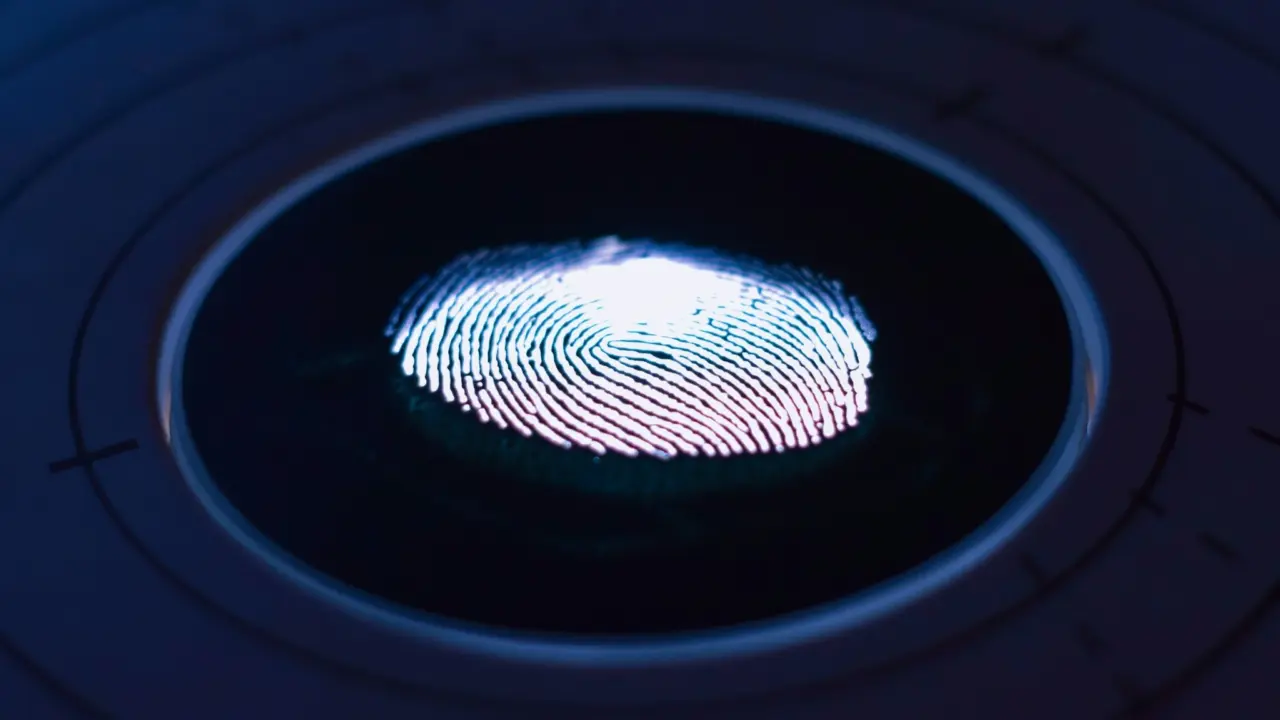
When a traveller is registered, the system records personal and travel-document information together with facial and fingerprint biometrics. At subsequent border crossings, authorities can check fingerprints and facial images against biometric information already stored in the system.
This makes identity verification less dependent on whether a document appears genuine and more dependent on whether the person presenting it matches a previously enrolled biometric identity.
The Commission has already pointed to cases where the technology detected travellers attempting to use different identities, illustrating one reason governments are investing heavily in biometric border systems.
A face match is a probability, not a perfect identification
Biometric systems can feel definitive because fingerprints and faces are associated with unique individuals. The underlying software, however, still has to compare captured data and decide whether two biometric samples are sufficiently similar.
In facial recognition, this commonly involves one-to-one verification: checking whether one image corresponds to another image associated with the claimed identity.
The U.S. National Institute of Standards and Technology describes two fundamental errors in facial recognition: false negatives, where software fails to associate two images of the same person, and false positives, where it incorrectly associates images of different people. NIST’s current evaluation framework tracks how those errors vary by age, sex and race.
Image quality matters too. NIST’s September 2026 update says poor lighting, exposure and camera positioning can increase false non-match rates, showing why the environment in which a biometric sample is captured matters alongside the algorithm itself.
Earlier large-scale NIST testing of 189 algorithms from 99 developers also found that the majority of tested face-recognition algorithms exhibited demographic differentials, although performance varied considerably among algorithms.
For border operators, the engineering challenge is therefore not simply installing a camera. Capture quality, matching thresholds, hardware placement and fallback procedures all affect whether automated identity checks work reliably across millions of travellers.
Faster borders can still create new bottlenecks
Automation is often sold partly on convenience.
The Commission says the EES enables greater use of automated border controls and self-service systems, potentially making repeat crossings more efficient once travellers are enrolled.
But biometric processing also introduces new steps.
In August, Euronews reported that EES implementation had contributed to waits of up to two hours at some major European airports, with Frankfurt, Amsterdam and Munich among the hubs experiencing significant delays.
That tension is familiar in large technology deployments. Digitising a process does not automatically make the entire system faster. Enrollment, fingerprint capture, camera failures, unfamiliar travellers and exception handling can shift friction from paperwork into machines.
A 2025 open-access dataset based on border-technology pilots at Tallinn, Athens, Larnaca and Vienna airports and Romania’s Moravița land border collected travellers’ perceptions specifically to study technology acceptance and operational experience with automated border-control systems.
Human acceptance therefore becomes part of infrastructure performance.
Biometric convenience creates a different privacy problem
Fingerprints and facial templates are fundamentally different from passwords.
A compromised password can be changed. A person cannot replace their face.
That is why the European Data Protection Board stresses that the EES processes sensitive personal data and that travellers must be able to exercise rights including access, rectification, completion, erasure and restriction of their information.
The EU Agency for Fundamental Rights has similarly highlighted the need for privacy protection, dignified biometric collection and accessible information for travellers, particularly for children, older people and persons with disabilities.
The architecture matters as well. A 2026 open-access study of biometric airport check-in systems notes that centralized facial-recognition systems raise privacy concerns because biometric information is stored and transmitted through centralized infrastructure, and evaluates federated alternatives designed to reduce some of that exposure.
The border is becoming a biometric computing system
For travellers, the visible experience may remain simple: passport, camera, fingerprint scanner, gate.
Behind that interaction sits one of Europe’s largest identity infrastructures, connecting physical border checkpoints with databases capable of verifying people at continental scale.
That creates real advantages. Authorities can detect overstays automatically, identify some forms of document fraud and connect repeated border crossings to the same biometric identity.
But it also changes what a border check means.
A passport is an object a traveller possesses. Biometrics make the traveller’s face and fingerprints part of the authentication mechanism itself.
For the technology industry, airports and borders are therefore becoming one of the clearest demonstrations of what large-scale digital identity looks like when deployed in everyday life.
The important question is no longer whether biometric identity will become infrastructure. Across Europe’s borders, it already has.
The harder engineering and policy challenge is ensuring that systems powerful enough to recognize millions of people are also accurate, secure, transparent and accountable enough to deserve that role.