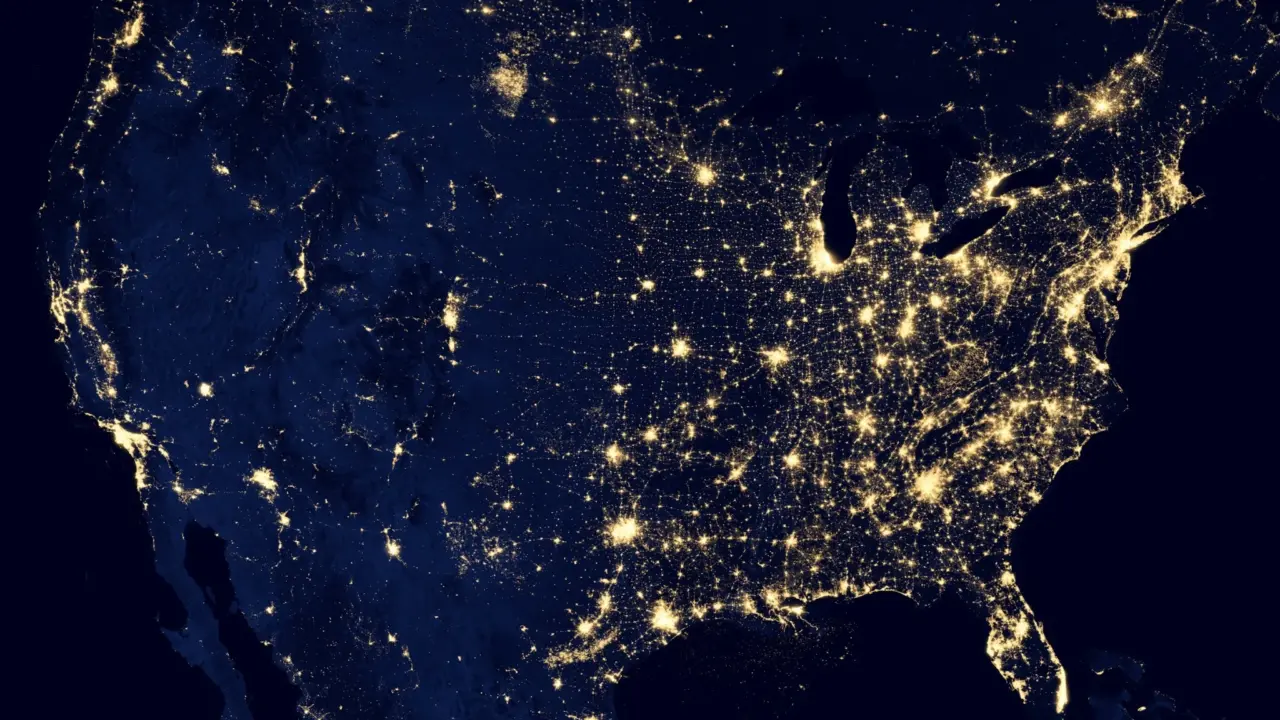

Artificial intelligence often feels weightless. A chatbot answers in seconds, a cloud app stores files invisibly, and a video recommendation appears without showing the machines behind it. But the AI and cloud boom is not floating in the air. It is running through physical buildings filled with servers, chips, cooling systems, backup power, fiber cables, and water infrastructure.
The hidden cost of digital convenience is becoming harder to ignore. As companies race to build larger AI models and expand cloud services, data centers are becoming some of the most resource-hungry parts of the modern internet. The issue is not only electricity. It is also water, land, emissions, e-waste, and pressure on local communities.
The Cloud Has a Physical Footprint
Data centers are the industrial backbone of modern computing. They store files, process transactions, host apps, train AI models, stream videos, and power cloud services used by governments, companies, schools, and consumers. The more people rely on AI and cloud platforms, the more physical infrastructure is needed to support them.
Reuters reported that data centers are expected to consume twice as much power and water by 2030 as they expand to meet demand from artificial intelligence, according to researchers from the United Nations University Institute for Water, Environment and Health.
The rapid rollout of AI could strain scarce land resources and create growing amounts of electronic waste if governments do not address the environmental costs.
That matters because digital infrastructure is often marketed as clean, efficient, and invisible. But every query, file transfer, video stream, and AI response depends on machines that require power to run and cooling to survive.
Electricity Demand Is Growing Faster Than the Grid
The first major cost is electricity. AI systems require large amounts of computation, especially when companies train and run advanced models across thousands of chips. Those chips produce heat, and the systems supporting them must run continuously.
The International Energy Agency said global electricity consumption from data centers is projected to double to around 945 terawatt-hours by 2030, representing just under 3% of global electricity consumption. Data center electricity demand is expected to grow by around 15% per year from 2024 to 2030, more than four times faster than electricity consumption from all other sectors.
Those figures show why the AI boom is becoming an energy planning problem. A data center is not like an ordinary office building that can reduce activity overnight.
Cloud services need uptime. AI infrastructure needs stable power. If electricity demand rises faster than grids can adapt, utilities may rely on fossil fuels, delay clean-energy transitions, or pass infrastructure costs to consumers.
The environmental impact also depends on where data centers are built.
A 2026 study on U.S. hyperscale data centers estimated that 403 facilities operating between May 2024 and April 2025 consumed about 68 to 99 terawatt-hours of electricity and were linked to around 37 to 54 million metric tons of carbon dioxide. About 54% of the attributed electricity generation for those hyperscale data centers came from fossil-fuel sources.
In other words, a data center’s climate footprint is not determined only by its servers. It is shaped by the local grid.
Water Is the Less Visible Cost
Water is the second major environmental pressure. Data centers generate heat, and cooling systems are needed to keep servers running safely. Some facilities use air cooling, some use liquid cooling, and others use evaporative cooling systems that can consume large amounts of water.
The United Nations University report said AI-related water use could match the basic annual needs of 1.3 billion people by 2030. The Business Times, reporting on the same UN research, said water consumption from data centers is expected to reach 9.3 trillion litres by 2030.
This is where local geography becomes important. A data center built in a water-secure region may be easier to manage. A data center built in a drought-prone area can intensify competition between technology infrastructure, households, farms, and ecosystems.
Water use can also be indirect. Even when a data center uses less water on site, the electricity it consumes may come from power plants that require water for cooling. This means the environmental footprint can be hidden in the energy supply chain.
A 2025 study on AI servers found that the design of cooling systems and the geographic location of data centers can influence environmental impact as strongly as hardware efficiency. Advanced cooling technologies can reduce cooling energy by up to 50%, while locating facilities in low-carbon and water-secure regions can cut combined footprints by nearly half.
AI Makes Efficiency More Complicated
Technology companies often argue that chips and data centers are becoming more efficient. That is true in many cases. New hardware can perform more calculations per watt. Better cooling systems can reduce waste. Smarter software can improve utilization.
But efficiency does not always reduce total consumption. When a technology becomes cheaper and more useful, people often use more of it. AI is a clear example. More efficient models may lower the cost of generating text, images, code, audio, and video, but that can also encourage companies to add AI to every product.
This is why the environmental debate cannot focus only on efficiency. It must also ask how much AI is being deployed, where infrastructure is being built, and whether the growth is matched by clean power, responsible cooling, and transparency.
Reuters reported that United Nations Secretary-General António Guterres urged AI companies to fully disclose the environmental impact of their data centers, including water, carbon, and land use. Guterres launched the U.N.’s AI Environmental Transparency Initiative and called for all AI data centers to run on renewable energy by 2030.
Transparency matters because users cannot evaluate what they cannot see. A chatbot response may appear instantly, but the public rarely knows which data center processed it, how much power was used, what cooling system was involved, or whether the electricity came from renewable sources.
Local Communities Are Feeling the Pressure
The environmental cost of data centers is not only global. It is local. Communities may face new power substations, transmission lines, water withdrawals, backup diesel generators, construction noise, land-use conflicts, and higher utility demand.
Reuters reported that city leaders from London to Melbourne joined efforts to curb the burden of data centers on electricity grids, water resources, and communities through the Global Urban Data Centres Pact. Melbourne’s mayor said data centers could account for up to 20% of the city’s energy use by 2040 and consume 4% of its drinking water.
Those numbers show why local resistance is growing. A data center may support global cloud services, but its costs are often concentrated in one region. The benefits can be abstract, while the power lines, water demand, and land use are immediate.
The AI Boom Needs Environmental Accounting
The answer is not to stop using cloud services or reject AI entirely. Data centers support medicine, education, finance, science, emergency services, and communication. AI may also help improve energy systems, climate modeling, logistics, and industrial efficiency.
But the industry needs clearer environmental accounting. That means reporting electricity use, water use, carbon emissions, land footprint, cooling methods, renewable energy sourcing, and local impacts in a way that can be verified.
The hidden environmental cost of AI and cloud computing is no longer hidden because researchers, regulators, cities, and communities are beginning to count it. The next phase of digital progress will not be judged only by faster models or smarter apps. It will also be judged by whether the physical infrastructure behind them can grow without exhausting the power, water, and land that everyone else depends on.