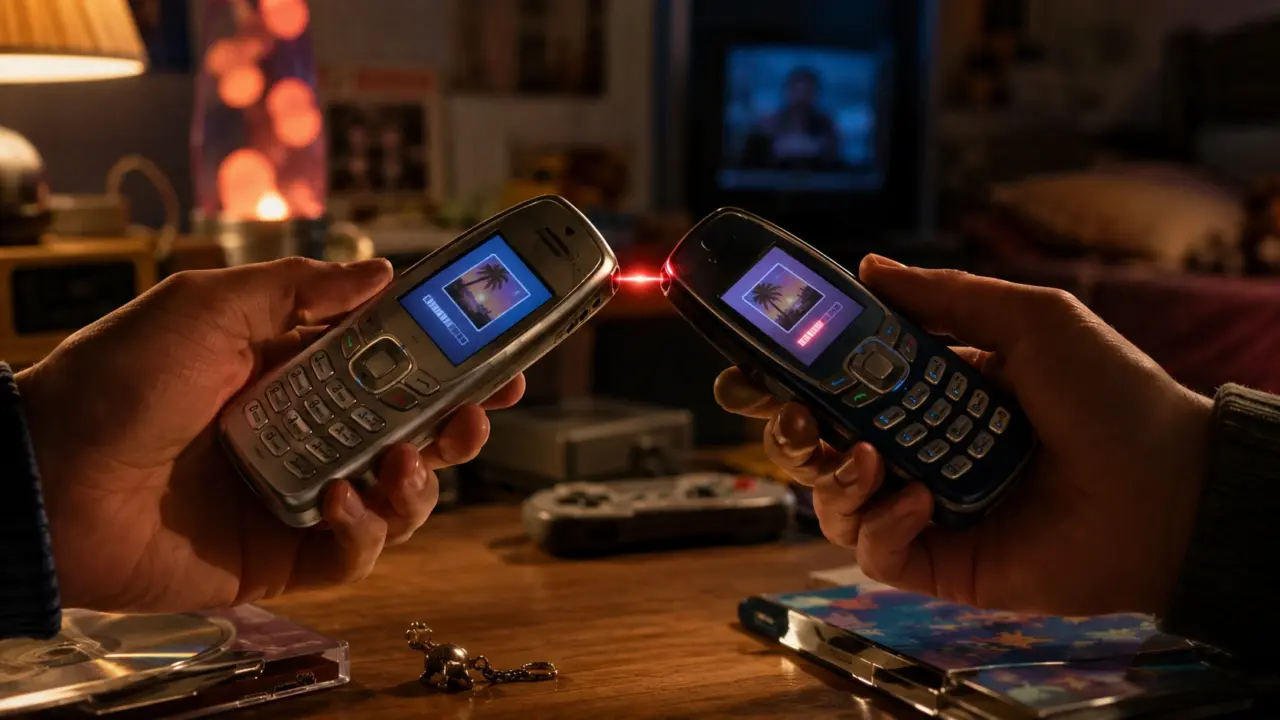
Before AirDrop, Bluetooth sharing, cloud albums, and messaging apps, there was a strange little ritual that many early mobile users remember: placing two phones face-to-face, lining up their infrared ports, and waiting patiently for a ringtone, contact, or blurry photo to travel through invisible light.
It felt futuristic at the time. There were no cables, no internet connection, and no need to send the file through a network. But it also felt fragile. Move one phone slightly, block the tiny infrared window, or pull the devices too far apart, and the transfer could fail.
That was the charm and frustration of infrared file sharing. It gave early mobile users a taste of wireless convenience, but only if they performed the transfer almost like a small ceremony.
Infrared Sharing Was Built on Invisible Light
The science behind infrared file sharing was simple in concept but strict in practice. NASA explains that infrared waves, or infrared light, are part of the electromagnetic spectrum, and that people cannot see infrared light even though they encounter it every day. The same type of invisible light is used in common remote controls, which NASA describes as devices that use infrared light waves just beyond the visible spectrum to change TV channels.
Mobile phones and laptops used a standardized version of that idea. Instead of using radio waves, infrared ports sent data through light pulses from one device to another. This is why the phones had to “see” each other. The transfer did not float freely around the room like Wi-Fi or Bluetooth. It moved in a narrow optical path.
The Infrared Data Association, or IrDA, helped make that possible as a standard. Vishay’s technical document on IrDA says the Infrared Data Association was established in 1993 to create hardware and software standards for infrared communication links. The same document describes IrDA as a low-cost, low-power, half-duplex, serial data interconnection standard built around a “walk-up” and “point-to-point” user model.
Those words explain the old experience perfectly. You walked up to another person, pointed your device at theirs, and made a temporary connection.
The Ritual of Aligning Two Phones
Infrared file sharing was memorable because it made wireless technology feel physical. The user had to find the tiny black or dark-red infrared window on each device, place both phones close together, and keep the ports aligned until the transfer finished.
That careful alignment was not just user superstition. It was a technical requirement. Vishay explains that IrDA transmission uses an infrared emitting diode on one transceiver and the receiving part of a second transceiver. The same document says the optical output power and receiver sensitivity were designed for a “point-and-shoot” activity within about ±15 degrees for point-to-point communication.
In other words, the system expected users to aim. This is why sending a file by infrared felt different from sending something today. Modern sharing is mostly invisible. A person taps “send,” chooses a contact, and the device handles the rest. Infrared made the user part of the connection itself.
For small files, that was enough. A ringtone, contact card, or low-resolution image could feel magical when it arrived. But for larger files, the limits became obvious. A transfer could take time, and the phones had to remain in position. Someone bumping the table or picking up the phone too early could ruin the moment.
It Was Wireless, but Not Effortless
Infrared sharing was impressive because it removed the cable. But it did not remove inconvenience.
Vishay’s IrDA physical layer document says IrDA released standards in June 1994 and later expanded the standard with high-speed extensions of 1.152 Mbit/s and 4.0 Mbit/s. Those numbers sound modest now, but they were meaningful in an era when files were smaller and phones were simpler.
The same source explains one reason transfers felt sensitive: the IrDA system works in half-duplex mode, meaning only one transmission direction can be active at a given time. It also says standard links operated to at least one meter, while low-power options had shorter ranges such as 0.2 meters.
That made infrared useful, but limited. It worked well when two people were nearby and intentional about the transfer. It was not designed for casual background sharing, room-wide connectivity, or multiple devices communicating at once. It was personal-area networking in the most literal sense: two devices, close together, facing each other.
Infrared Had a Hidden Security Advantage
Its limitations also gave infrared an unexpected benefit. Because IrDA required close range and direct aiming, it was harder to accidentally send data to the wrong person across the room.
Barr Group’s comparison of short-range wireless protocols says infrared communications work best in line-of-sight, point-and-shoot uses such as exchanging business cards. The same article notes that a user may not want to send a business card to every possible receiver nearby.
That point captures why infrared once made sense. It was private by physical design. The narrow beam and short range made the act of sharing deliberate. You knew who was receiving the file because their device was right there, pointed at yours.
The same Barr Group comparison says IrDA is directional and line-of-sight, while Bluetooth is omni-directional and can connect through solid, non-metal objects. That difference helped explain both the appeal and the decline of infrared.
Infrared was direct. Bluetooth was flexible.
Bluetooth Changed the Meaning of Wireless
Infrared began to feel outdated when wireless sharing no longer required aiming. Bluetooth did not need two devices to face each other. It worked through radio frequency, could discover nearby devices, and eventually became standard in phones, headsets, laptops, cars, speakers, keyboards, and wearables.
Bluetooth’s official history says Ericsson, IBM, Intel, Nokia, and Toshiba formalized a wire replacement for communicating voice and data between devices in the mid-1990s. The Bluetooth Special Interest Group was formed on May 20, 1998, according to Bluetooth’s official history page.
Bluetooth’s advantage was not only speed or range. It changed user expectations. Bluetooth’s official history says the first PC card and first mobile phone with Bluetooth technology came to market in 2000. Once people became used to devices discovering each other without perfect alignment, infrared started to feel fussy.
Barr Group’s 1999 comparison already saw the difference clearly. The article says Bluetooth-enabled devices can discover each other automatically and form ad-hoc “piconets” of up to eight devices. That was a very different world from placing two phones nose-to-nose on a table.
Bluetooth made wireless feel passive. Infrared made wireless feel manual.
The Fall of Infrared Was Really a Change in Habits
Infrared did not disappear because it was useless. It disappeared because people wanted sharing to require less attention.
As phones became smarter, people wanted to send larger photos, songs, videos, documents, and eventually entire albums. They wanted wireless headsets, car connections, portable speakers, and syncing that happened in the background. Infrared’s line-of-sight design could not fit that future comfortably.
Its decline was also cultural. Early mobile users tolerated slow transfers because the files were small and the novelty was high. A ringtone or wallpaper felt worth the wait. But once messaging apps, Bluetooth, Wi-Fi, cloud backups, and social platforms arrived, file sharing became less about two devices touching the same invisible beam and more about services moving data quietly behind the scenes.
Today, people send photos through chat apps without thinking about the path. They upload to cloud drives, scan QR codes, share links, or use nearby-sharing tools that hide most of the process. Convenience has improved, but something has also been lost: the visible effort of sharing.
The Tiny Port That Made Wireless Feel Personal
Infrared file sharing now feels like a relic because it belonged to a more physical era of digital life. Phones had visible ports. Files felt local. Sharing required presence. The person receiving the file had to be beside you, holding still, waiting with you.
That is why people remember it with affection. It was inconvenient, but it made technology feel understandable. You could see where the transfer was happening. You knew why it failed when the phones moved. You participated in the connection.
The rise and fall of infrared file sharing shows how far personal technology has moved. We did not just replace one wireless standard with another. We moved from careful, intentional, face-to-face transfers to invisible, automatic, always-connected sharing.
The old infrared port may be gone from modern phones, but its memory remains familiar to anyone who once held two devices together and waited for a tiny file to cross a beam of invisible light.