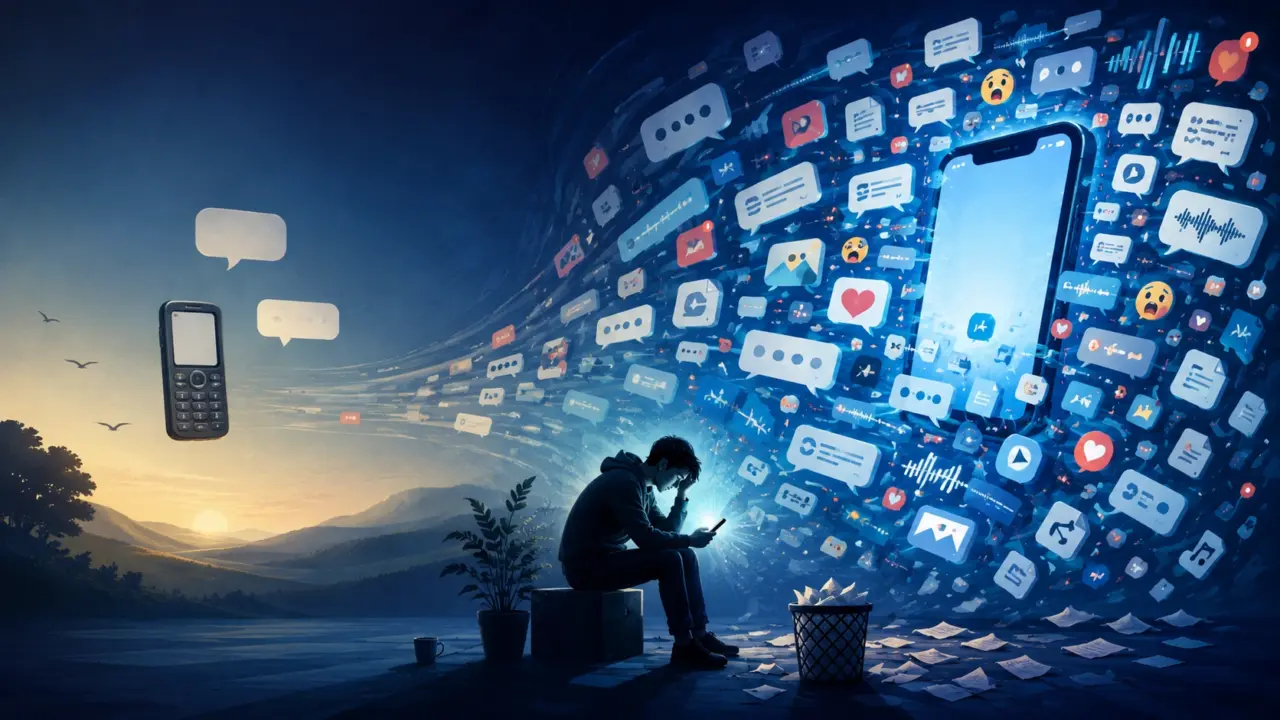
There was a time when every text message felt counted. People checked their prepaid load, shortened words to save characters, waited before replying, and treated every “GM” or “K” as a small decision.
Today, messaging feels almost free. A person can send voice notes, photos, reactions, stickers, files, memes, screenshots, and paragraphs across multiple apps without thinking about the cost of each message.
But something strange happened along the way. Messaging became cheaper, faster, and easier, yet it also became more tiring. The problem is no longer whether we can reach people. The problem is that people can reach us all the time.
The Old SMS Era Had Limits
The original SMS world was built around scarcity. A text message was short, direct, and often shaped by technical limits. A 2023 paper on SMS compression explained that conventional SMS uses seven bits for each character and allows a maximum of 160 characters in a standard SMS message. That limit influenced how people wrote: abbreviations, clipped sentences, symbols, and “text speak” became part of everyday communication.
The limit was not only technical. For many users, especially those on prepaid mobile plans, messaging also carried a visible cost. You had to think before sending. A long message could become several parts. A casual chat could consume load. The result was an old communication culture where people were reachable, but not endlessly reachable.
Even when texting became extremely popular, it still had a rhythm. Wired reported on Pew Internet findings from 2011 showing that American cell phone owners sent an average of 41.5 text messages per day, while users aged 18 to 29 averaged 88 texts per day. Those numbers looked huge at the time, but they were still mostly tied to one channel: the text inbox.
Today, the inbox is everywhere.
Messaging Moved From Scarcity to Abundance
Modern messaging apps changed the meaning of communication. Instead of paying per text, users moved into app-based platforms where messages ride on mobile data or Wi-Fi. That made conversations richer and cheaper. It also removed the old friction that forced people to pause.
Now one person can be reachable through Messenger, WhatsApp, Telegram, Instagram, iMessage, Viber, Discord, Slack, email, and workplace tools. Each platform has its own badges, tones, typing indicators, group chats, pinned messages, reactions, and read receipts. The cost of sending a message may feel close to zero, but the cost of receiving, processing, and responding to messages has grown.
This is why unlimited messaging can feel heavier than SMS load. In the old system, communication was restricted by credits, character limits, and signal. In the new system, communication is restricted mainly by attention.
Notifications Turn Conversation Into Interruption
The real burden of modern chat is not the message itself. It is the interruption attached to it.
Common Sense Media’s 2023 report on young people’s smartphone use found that participants received a median of 237 notifications on a typical day. About one-quarter of those notifications arrived during the school day and 5% arrived at night.
Those numbers help explain why messaging feels exhausting. A message is no longer just a message. It is a vibration during class, a red dot during work, a banner during dinner, a ping before sleep, or a badge that waits on the home screen until the user clears it.
Research shows that notifications can affect attention even when they seem minor. A 2022 study in the European Journal of Educational Research found that cell phone notifications caused distractions regardless of phone ownership and task difficulty, and increased the time needed to complete a task. Another study published through the National Library of Medicine examined smartphone notifications and cognitive control, noting that mobile technology use has been linked in prior literature to lower cognitive control during demanding tasks.
This is the scientific reason chat can feel draining. The brain does not process notifications as neutral background noise. Each alert asks for attention, even if the user decides to ignore it. The interruption itself becomes work.
Read Receipts Made Silence More Complicated
The old SMS era had uncertainty. A person could say the message arrived late, their phone had no load, or they simply did not see it. Modern messaging apps made communication more transparent, but also more socially demanding.
The Journal of Social Media in Society published a 2024 study finding that direct mobile messaging in developing romantic relationships is expected to be continuous, fast, and transparent. People strategically use features such as read receipts and Snapchat streaks to manage expectations in mobile messaging.
That expectation is not limited to romance. In family chats, work groups, school chats, and friendships, the same pressure appears: people see when you are online, when you are typing, when you opened a message, and sometimes when you chose not to respond.
A separate study on read receipts found that knowing a message’s status is visible to the sender can create a sense of being “forced to respond.” The study also said that read receipts can cause stress, frustration, a desire to be left alone, and feelings of being overwhelmed or guilty.
This is one of the biggest emotional changes in messaging. The burden is no longer just communication. It is performance. People must manage not only what they say, but also when they reply, how quickly they reply, whether their silence looks intentional, and whether their availability is being judged.
Group Chats Made Everyone Reachable at Once
Unlimited messaging also changed the scale of conversation. A single SMS was usually one-to-one. Group chats turned everyday communication into a many-to-many stream where multiple conversations can happen at once.
Group chats are useful because they coordinate families, classmates, coworkers, friends, clubs, and communities. But they also create constant partial attention. A person can miss 80 messages in a few hours and return to inside jokes, plans, arguments, reminders, photos, polls, and reactions that all feel urgent in different ways.
Workplace messaging adds another layer. A 2023 study on instant messaging, interruptions, stress, and work performance explained that when the volume of notifications and received messages exceeds a user’s capacity to manage them, the user perceives an additional burden to information overload. That sentence captures modern chat perfectly: the technology solved delivery, but not capacity.
Humans are not built to be in every conversation at the same time. Messaging apps make it possible, but not always healthy.
Turning Notifications Off Is Not a Perfect Escape
The obvious answer is to mute everything. But research suggests the solution is psychologically complicated.
A study titled “Productive, Anxious, Lonely” found that participants who disabled notification alerts for 24 hours felt less distracted and more productive. Some participants also felt anxious because they could no longer be as responsive as expected and felt less connected with their social group.
That finding explains why many people do not simply turn off their phones. Notifications are stressful, but silence can also feel risky. A muted phone may bring peace, but it can also create fear of missing a family emergency, a work message, a friend’s update, or a group decision.
Modern messaging therefore traps users in a strange bargain. Being available is tiring. Being unavailable can feel irresponsible.
The Real Price of Free Messaging Is Attention
The shift from SMS load to unlimited messaging is often described as progress, and in many ways it is. Communication became cheaper, faster, more expressive, and more accessible. Families separated by distance can stay close. Students can coordinate instantly. Workers can collaborate across time zones. Friends can send voice notes instead of waiting for a call.
But free messaging did not remove cost. It moved the cost from money to attention, from prepaid balance to mental bandwidth, and from character limits to emotional availability.
The old SMS era asked, “Do I have enough load to reply?” The modern messaging era asks a harder question: “Do I have enough energy to keep up?”
That is why chat became both better and more exhausting. We gained unlimited connection, but we also inherited unlimited expectation. The next challenge is not making messaging faster. It is learning how to make it quieter, kinder, and less demanding of the people who use it every day.